



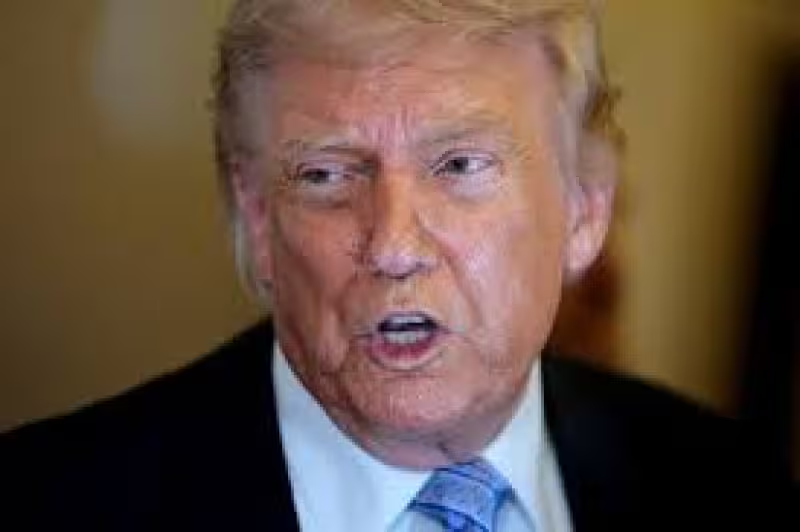
Donald Trump said Friday that U.S. and Nigerian forces killed the second in command of the Islamic State globally, Abu-Bilal al-Minuki.
"Tonight, at my direction, brave American forces and the Armed Forces of Nigeria flawlessly executed a meticulously planned and very complex mission to eliminate the most active terrorist in the world from the battlefield," Trump said.
In a series of statements he described al-Minuki as the group’s most active planner and credited intelligence partners for keeping him under observation. "Abu-Bilal al-Minuki, second in command of ISIS globally, thought he could hide in Africa, but little did he know we had sources who kept us informed on what he was doing," Trump said, and added, "He will no longer terrorize the people of Africa, or help plan operations to target Americans."
Trump also asserted the strike will have wider effects on the group’s reach. "With his removal, ISIS’s global operation is greatly diminished," he said, and he thanked the government of Nigeria for its partnership on the operation.
The president did not disclose exactly where the operation took place. Public records show al-Minuki, a Nigerian national, had been placed under U.S. sanctions in 2023 and designated a specially designated global terrorist that same year by the former Biden administration.
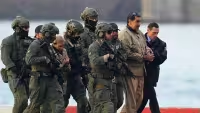

The killing follows a U.S. campaign of pressure in the region: the United States carried out strikes targeting Islamic State-linked militants in Nigeria in December, and Washington has since deployed drones and about 200 troops to provide training and intelligence support to the Nigerian military. Earlier this year, Nigerian military officials said U.S. forces were operating in a strictly non-combat role.
The number and nature of forces involved Sunday night — and the decision to publicly attribute the operation to both American and Nigerian troops — give weight to Trump’s claim that U.S. personnel played an active role. He told the public the mission was both "carefully planned and very complex," language he has used before to emphasize high-risk operations that rely on precise intelligence.
There is an immediate tension between that public portrayal and earlier statements from Nigerian officials about the U.S. role. If American troops provided the kind of support Trump described, it will deepen questions about what ‘‘non-combat’’ meant in practice and whether Washington’s footprint in Nigeria has moved beyond training and surveillance. The president’s announcement also arrives against a backdrop of prior friction: the source says Trump has previously accused Nigeria of failing to protect Christians from Islamist militants in the north-west, a charge Nigeria rejects, saying its security forces target armed groups that attack both Christians and Muslims.
For Nigerians and American planners alike, the figure that matters now is whether al-Minuki’s death will break networks on the ground or simply create a gap other commanders will rush to fill. The president framed the strike as a crippling blow to the group: "He will no longer terrorize the people of Africa, or help plan operations to target Americans," he said, and credited partners for making the operation possible.
The most consequential unanswered question is straightforward: where exactly did the mission take place, and will Washington clarify the role U.S. personnel played so soon after Nigerian officials described American forces as strictly non-combat? That answer will determine whether the announcement is the end of a targeted decapitation or the opening of a more active U.S. counterterror role in Nigeria and the wider region.