





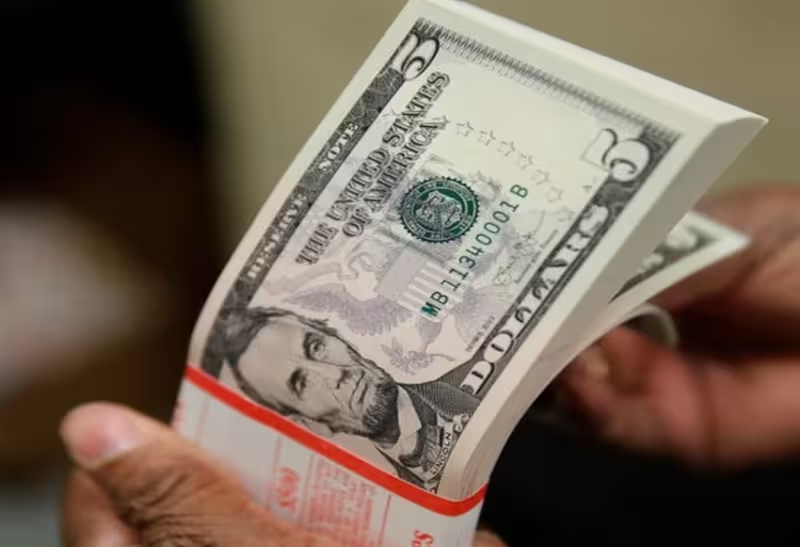
The naira slid to N1,361.5 per dollar on Friday, April 24, 2026, marking the currency's weakest close in three weeks and underscoring renewed exchange rate strain across official and parallel markets.
The weekly decline was steep: the local currency had closed at N1,342.5 a week earlier and then weakened through the week to N1,349.67 on Monday, N1,350.99 on Tuesday, N1,348.1 on Wednesday and N1,355 on Thursday before the N1,361.5 finish on Friday, a fall the report said amounted to nearly N20 in seven days.
Central Bank of Nigeria data cited by the reporting outlets showed the official foreign exchange market rate dipped on Friday to N1,358.44 per dollar, down from N1,353.91 on Thursday; the Daily Post Nigeria said that represented a N4.53 day‑on‑day loss and a N14.80 week‑on‑week drop.
Pressure was visible beyond the official window. At the black market the naira moved to N1,427 per dollar, up from N1,426 the prior day, with the Daily Post noting that parallel dealers reflected a N26 week‑on‑week loss. A separate early‑morning market snapshot on April 27 put the official rate at 1,352.25 NGN per 1 USD while a Vanguard report that same day estimated the parallel market around 1,475 NGN.
The April 24 close — the weakest since April 9, when the naira settled at N1,365 per dollar — arrived as Nigeria's external buffers showed modest erosion. Reports that compiled Central Bank and market data said external reserves stood at $48.48 billion on March 22, and Channels Television noted reserves had declined to about $48.4 billion from $48.54 billion at the start of the week on April 20.



Analysts and market accounts to which the reports attributed pressure point to a cluster of immediate factors behind the moves: seasonal demand for foreign currency, limited supply from official channels, constrained FX inflows, a stronger U.S. dollar globally and volatility in oil prices. Those conditions, the reporting said, pushed activity into parallel markets where rates are far wider than the official windows.
The clearest tension in the data is the growing disconnect between official quotations and what traders pay on the street. While official trades finished the week in the N1,350–N1,358 range and early Monday trades showed 1,352.25 NGN per dollar, the parallel market reports placed the dollar between N1,427 and about N1,475 — a gap that complicates pricing for importers, remitters and businesses relying on both channels.
That divergence coincided with a week in which official rates fluctuated between 1,355.80 NGN and 1,350.00 NGN, according to the Vanguard summary, suggesting short‑term stability in the formal window even as overall pressure mounted and black market rates climbed.
The immediate consequence is straightforward: businesses and households face higher costs when they must buy dollars on the parallel market, and budget planners that use official rates confront a mismatch between recorded prices and market reality. The near‑term outlook depends on two measurable levers: a pickup in FX inflows or sustained intervention via official supply to narrow the gap.
Given the track of rates through April 24 and the early April 27 snapshots, the facts point to continued volatility unless those inflows materialize or authorities move to close the disconnect. The most consequential question now is whether official channels can replenish foreign currency supplies enough, quickly enough, to stop the exchange rate divergence from widening further and to stabilize the reserves shown slipping toward the $48.4 billion mark.