





Ukraine marked the 40th anniversary of the Chernobyl nuclear accident on Sunday as journalist Jessica Parker walked the empty streets of Pripyat, the abandoned city where plant workers once lived.
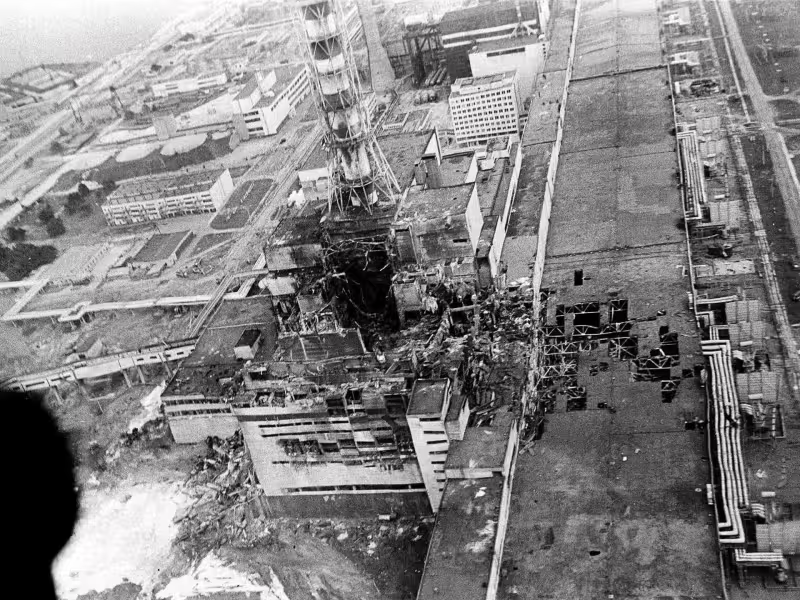
The explosion of reactor number 4 on 26 April 1986 sent radioactive material across swathes of Europe and prompted the creation of a restricted Chernobyl Exclusion Zone roughly 30km in diameter to contain contamination. The officially recorded death toll from the accident stands at 31; a 2005 study by several UN agencies estimated that as many as 4,000 people could ultimately die as a result of the incident.
The scale of the damage is still stark. The destroyed Unit 4 reactor remains capped beneath the New Safe Confinement, which Ukraine says was damaged after Russian forces briefly occupied the exclusion zone following the launch of a full-scale invasion on February 24, 2022. Russian forces pulled back from the zone by the end of March 2022, but Kyiv has accused Moscow of firing drones into the area and of causing harm to the structure meant to seal the wrecked reactor.
Technical assessments cited in reporting note how extreme the conditions were at the heart of the blast: radiation levels inside the ruined reactor spiked to about 20,000 roentgens, and contamination spread over vast areas — more than 145,000 square kilometres, according to one supplementary account. Those figures underline why the exclusion zone was established and why it remains tightly controlled decades later.
The anniversary revived old controversies as well as new worries. For many survivors and evacuees, the early hours and days after the explosion remain a nightmare. Officials and historians still disagree over the wider health toll and the long-term human cost; the 31 officially recognized deaths sit uneasily beside the UN agencies’ 2005 projection of 4,000 eventual deaths. The wider impact of the chernobyl disaster remains contested and difficult to determine.
Ivan Kholostenko, writing in a supplementary piece, argued that Soviet authorities compounded the harm by forcing people to participate in public demonstrations in Kyiv on May 1 even after dangerous radiation levels were present in the air. He said those actions worsened the consequences and exposed a system built on secrecy and disregard for human life — a condemnation that underlines both mismanagement at the time and the difficulty of establishing a definitive account of harm.
The tension today is immediate and mechanical as well as historical. The damaged Unit 4 stays under the New Safe Confinement, and any breach or further damage could pose renewed risks. Kyiv’s accusations that Russian forces fired drones into the exclusion zone and harmed the containment point to a new era in which war can intersect with fragile nuclear safeguards.
Four decades on, the New Safe Confinement’s integrity and the unsettled estimates of casualties are not abstractions. They determine whether large tracts of land, restricted since 1986, will ever be treated as anything other than contaminated territory. They shape the lives of people who still reckon with displacement and uncertainty. And they frame how Ukraine marks this anniversary: not as a closed chapter, but as a reminder that the accident’s physical and human repercussions are still being measured.
Jessica Parker’s walk through Pripyat on Sunday echoed that unresolved weight. The empty schoolrooms and rusting playgrounds are the visible proof that the disaster was not a single moment but the start of decades of containment, debate and, for many, a living nightmare that has yet to fully end.