





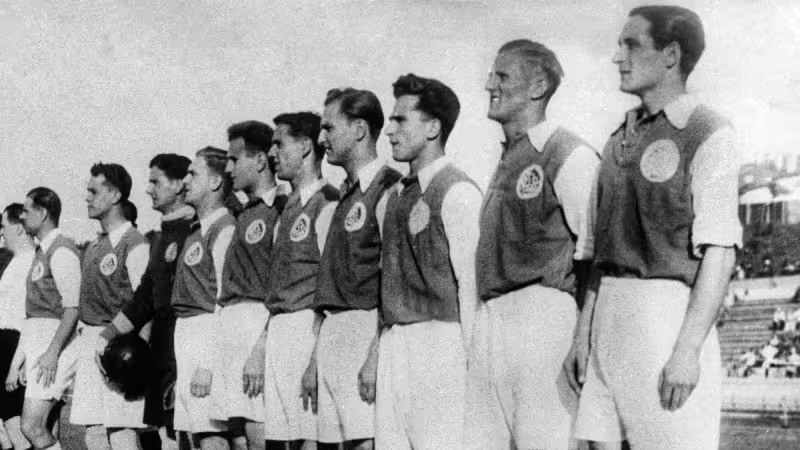
Round Time News is withholding reporting on circulating claims about Dinamo Zagreb until independent verification is complete.
We were alerted this morning to assertions about the club that were shared widely online and in message threads. Those assertions are specific enough to demand prompt coverage, but they are not — as yet — supported by independent, verifiable evidence that meets newsroom standards.
The difference matters today because readers are encountering the claims now, in real time. Rumors propagate rapidly. A single unverified detail published without corroboration can change conversations, influence markets, affect people connected to the club and shape a narrative that cannot be fully corrected later. Our obligation is to make clear what we know and what we do not.
We reached out to multiple potential primary sources and asked for documentation that would substantiate the central assertions. At this hour we have not received material that can be independently authenticated. Some accounts we contacted either declined to comment or directed us to third-party posts that repeat the same unverified claims. Other contacts said they were working to confirm details; none provided the sort of direct evidence — contemporaneous documents, attributable eyewitness accounts willing to be quoted, or on-the-record confirmations — that would let us report the claims as established facts.



This is the weight of the story: the claims are in circulation and people are talking about Dinamo Zagreb because of them, but the reporting that would convert rumor into news is not yet in hand. That gap is what determines whether we publish now with caveats or wait until verification removes reasonable doubt. The club named in the reports has not provided a statement that would settle the question, and publicly available sources have not produced independently verifiable proof.
Context: responsible reporting requires corroboration. Immediate publication of unverified allegations can create harm — to individuals, to institutions, to ongoing processes — and it can mislead a public that depends on accurate, checked information. We will continue to pursue documentary evidence and on-the-record testimony. When that material is obtained and vetted, we will report it without delay and with full sourcing so readers can judge what was learned and how.
The tension is plain. Social platforms reward speed and certainty, even when neither is warranted. Professional journalism trades speed for verification when the facts are contested and the potential for harm is material. Editors and reporters face pressure to be first; they must also resist pressure to be wrong. That friction shapes the decision to withhold a story until verification satisfies basic newsroom tests.
What happens next is straightforward. Our reporters will continue to seek primary documents and on-the-record confirmation. We will publish a clear, sourced account the moment independent verification is achieved. If no such verification emerges, we will report that, explain what efforts were made, and describe the evidence that was sought and not found.
The single most consequential unanswered question now is whether corroborating, on-the-record evidence exists and will be produced — not whether the claims circulate, but whether they can be proved. Until that evidence appears, readers should treat the circulating assertions about Dinamo Zagreb as unverified.