





President Donald Trump ordered Steve Witkoff and Jared Kushner to abandon plans to fly to Islamabad for talks with iranian officials, saying he would not send private emissaries on long flights and that Tehran could call Washington instead.
The White House had announced late Friday that Witkoff and Kushner would head to Pakistan on Saturday for what was described as a three-leg tour to press for diplomacy, only for Trump later in the day to say the trip would not go ahead. Trump framed the decision as a refusal to send envoys on an “18-hour flight” to hold talks that he considered unnecessary and said future discussions could happen by phone if Iran wanted to engage.
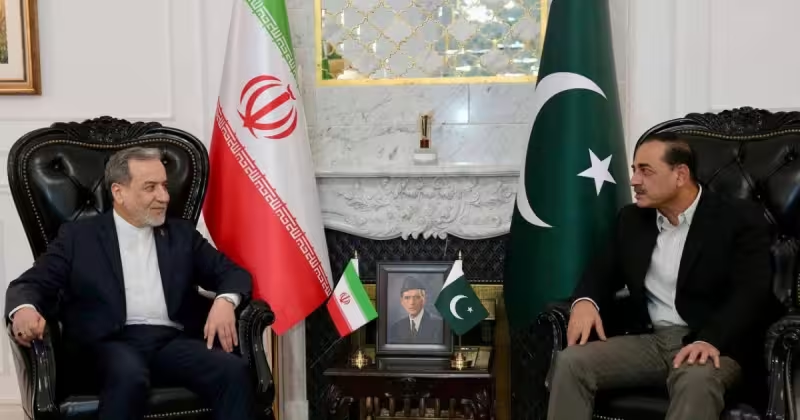
Meanwhile, Iran’s lead negotiator Abbas Araghchi carried out meetings in Islamabad on Saturday with Prime Minister Shehbaz Sharif, Army chief Asim Munir and Foreign Minister Ishaq Dar, then left the Pakistani capital after those talks. Pakistan said it remained committed to serving as a mediator between Washington and Tehran and described the meetings as warm and constructive; Prime Minister Sharif emphasized Islamabad’s continued willingness to act as an honest and sincere facilitator for regional peace.
Araghchi told Pakistani officials that he had conveyed Iran’s position on a workable framework to permanently end the war on Iran and that he would travel next to Muscat for meetings with Omani officials, with plans thereafter to go to Russia to discuss efforts to end the conflict. He also said he had yet to see whether the United States was truly serious about diplomacy.


The intervention comes against the backdrop of an ongoing war that began on February 28 and broader regional tensions that have produced a standoff in the Strait of Hormuz, a critical waterway through which roughly one-fifth of global oil and liquefied natural gas shipments transit. Iranian Revolutionary Guard Corps forces on Saturday said they did not intend to lift what has effectively been a blockage of the waterway, a posture that has compounded fears about energy and shipping disruption. The conflict has involved the deployment of forces numbering more than 50,000, according to available figures tied to the crisis.
The immediate clash between Washington’s posture and Pakistan’s shuttle diplomacy underscores a central friction: Islamabad says it can be a neutral facilitator and has hosted detailed talks, while the U.S. president signaled he would not endorse in-person back-channel missions and prefers direct, immediate contact from Tehran. Trump framed his decision as preserving leverage, insisting he holds all the cards and that the United States would not tolerate what he portrayed as futile long-haul envoy missions.
That public split leaves the most consequential question on the table: whether Pakistan can parlay the contacts it has convened into any durable negotiating momentum without U.S. participation in person. Araghchi’s next stops — Muscat and then Russia — will be watched for signs that Tehran can build an alternative diplomatic path or secure commitments that might sidestep Washington’s current stance.
For Abbas Araghchi, the trip that ended in Islamabad looks less like the start of a mediated breakthrough and more like the first move in a circuit of meetings intended to test whether rival capitals are willing to translate talk into tangible steps to end a two-month conflict. His next rounds of talks will help determine whether the teeth of diplomacy can match the rhetoric on display this weekend.