




Eileen Kelly, 30, published a Vogue column online on April 21 to defend her relationship with Anthony Kiedis, 63, saying the 33-year age gap did not register at first because she had met someone she found interesting and magnetic.
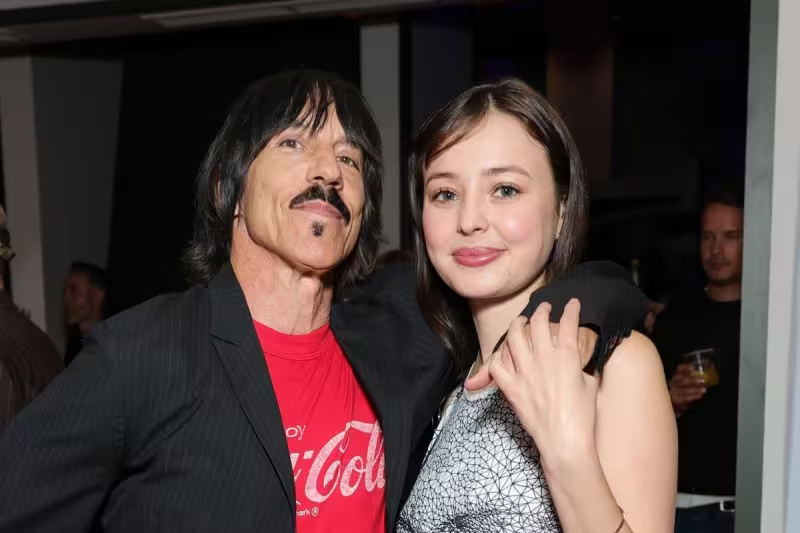
Kelly lays out a short timeline: they met at a birthday party, exchanged numbers, were spotted holding hands around the Grammys in February 2026, and posed together at Madonna and Guy Oseary’s Oscars afterparty in March 2026 before she wrote the column in April.
Her piece is blunt about what the pairing looks like from the outside and what it feels like from the inside. "It’s my first time dating someone significantly older, and sometimes I joke with friends that I’ve been missing out my whole life," she writes. She says the couple bonded over a shared connection to Hawaii and that "He is fully aware that he’s one lucky bastard."
Kelly gives the numbers plainly: she is 30, he is 63, and the gap between them is 33 years. She also confronts the common complaints: people have asked whether Kiedis is her father, she has been mistaken for his daughter on multiple occasions, and, the sources say, she has even lost a friend over the relationship. The sources say Kiedis has faced criticism over dating significantly younger women over the years.
The weight of that criticism is what makes the column news: Kelly did not simply offer a private explanation, she pushed back on the public frame. She acknowledged that concerns about power imbalance can exist in age gap relationships and that those concerns sharpen when one partner provides financial or emotional stability for the other. At the same time she insisted the balance in this case is different. "I’m not at risk of losing everything if we break up because I have my own money, my own career, and my own home," she wrote.
Kelly also tried to draw a line everyone can understand: "If I were 18, or even 21, the scales would be weighted far differently." That sentence is the clearest concession in the piece — she accepts that age changes the equation when one partner is barely an adult. But she added that in her situation, with mutual connection and her own independence, the relationship feels like "We’re mostly just two people doing the ongoing, unremarkable work of moving through life together."
Context matters here. Kelly is described as a writer, podcaster, social media personality, sex educator, and Vogue columnist, positions that give her both a platform and a vocabulary for addressing public scrutiny. Kiedis, meanwhile, is a public figure whose romantic history has drawn attention; the sources say that pattern helps explain why strangers and acquaintances react strongly when he dates someone much younger. The couple’s public appearances at high-visibility industry events have only intensified that reaction.
That contrast creates the tension Kelly names but does not fully resolve. She insists her independence removes the stereotype of a younger partner who depends on an older one for security. Yet the facts she cites — the questions about fatherhood, the friend lost over the relationship, and the long-standing criticism of Kiedis’s dating history — are the very evidence critics use to argue that appearances and power dynamics matter regardless of individual claims.
Kelly’s column is, in effect, an attempt to change the frame: she asks readers to consider consent, mutual interest and material independence before reducing the relationship to a scandal. Her most explicit claim is personal and simple — "It’s my first time dating someone significantly older, and sometimes I joke with friends that I’ve been missing out my whole life."
The conclusion her piece presses is clear and supported by the facts she provides: Kelly argues that this relationship is consensual, grounded in shared experiences and not exploitative because she stands on her own. That does not erase the broader debate about age gap relationships, nor does it prevent continued criticism of Kiedis given his history; but on the central question she raises — whether she is being taken advantage of — her argument rests on a stated financial and emotional independence that, by her account, makes the pairing different from the cases critics most often cite.