

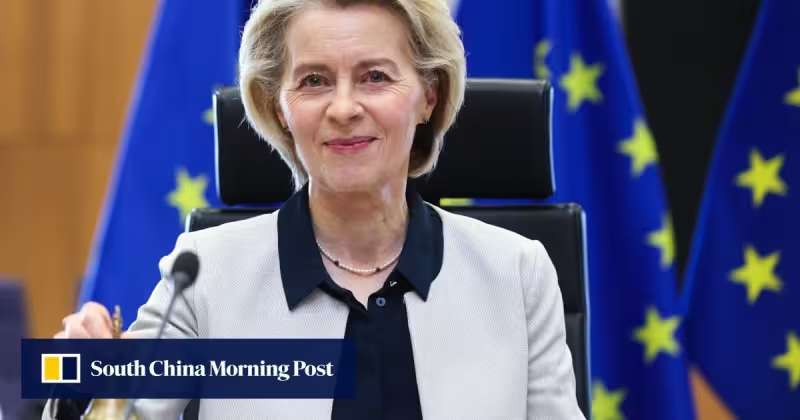
The European Union will expand its toolkit to defend its economy against imbalanced trade with China, EU officials say, and a special meeting of commissioners on Friday will debate using import quotas, tariffs and other safeguard measures to level the playing field.
Stephane Sejourne, speaking ahead of the meeting, said the bloc would step up targeted measures in sectors where surging imports and alleged distortions have been most visible — naming chemicals, metals and clean technology — and he framed the move as one of balance rather than rupture. "Our objective is not to break with China but to have a real rebalancing and real measures that allow us to do it," Sejourne said.
The case for action has been sharpened by rising trade imbalances: China's booming exports have produced large surpluses with many of Europe's top economies, a development that, officials and businesses say, leaves key industries exposed. Reporting this week in the Financial Times prompted Brussels to schedule the special meeting, and the South China Morning Post has reported that most commissioners support a more robust stance and broader use of safeguard measures ahead of Friday's debate.
What commissioners will discuss is specific. Sejourne said measures would include import quotas and tariffs targeting certain sectors, and the South China Morning Post reported he will also argue for wider deployment of the foreign subsidies regulation — a tool meant to address market distortions caused by state-backed advantages. Safeguard measures, the Post noted, can impose tariffs or quotas in response to surges in imports; the reporting also put the chemicals and machinery sectors squarely in view.
The procedural stakes are immediate. The supplementary reporting said anti-dumping and anti-subsidy probes could be shortened to about six months through the use of safeguard fast-tracks, a shift that would compress investigation timelines and make remedies available far sooner than under the current cadence.


The friction at the heart of the debate is political as much as technical. Officials say they want to avoid an all-out break with China while still confronting what they see as unfair competition; that dual aim creates awkward trade-offs. Stepping up tariffs or quotas risks retaliation, supply-chain disruption and higher costs for European industries and consumers, even as doing nothing risks long-term hollowing-out in sensitive sectors.
Commissioners who favor a tougher line argue that the current imbalance has left entire supply chains vulnerable and that new tools are necessary to prevent market distortions from becoming permanent. Opponents worry that aggressive protection could harm downstream manufacturers and that safeguards must be calibrated narrowly to avoid collateral damage. The Post's reporting suggests most commissioners now lean toward more robust measures, but the exact design — which sectors, what thresholds, whether quotas or tariffs, and how to pair action with diplomacy — remains unresolved ahead of Friday.
The choices made at the meeting will steer what comes next: a broadened use of the foreign subsidies regulation, a faster track for probes that could deliver relief in roughly six months, and the potential imposition of quotas or tariffs in targeted industries. Those decisions will reverberate through markets and supply chains and could shape EU-China economic relations for years.
For now, Sejourne's framing — that the goal is rebalancing rather than rupture — is the line Brussels will use to sell the shift. But the coming measures, if endorsed on Friday, will mark a clear turning point in how the 27-nation group manages trade with China and signal that policymakers are prepared to use tougher instruments to protect key European industries.
As commissioners gather, businesses and political leaders across the bloc will watch to see whether rhetoric becomes enforceable policy; for firms already navigating tariffs, quotas and a fast-changing regulatory landscape, the outcome will determine whether the next six months bring relief or a new round of uncertainty. In that sense, Friday's meeting is about much more than a policy tweak — it is a choice about how Europe intends to coexist economically with china in the decade ahead.
While Brussels argues for balance, the unanswered practical question after Friday is straightforward: can the EU design measures that arrest damaging import surges without tipping trade relations into a damaging spiral — and can it do so quickly enough to matter?