


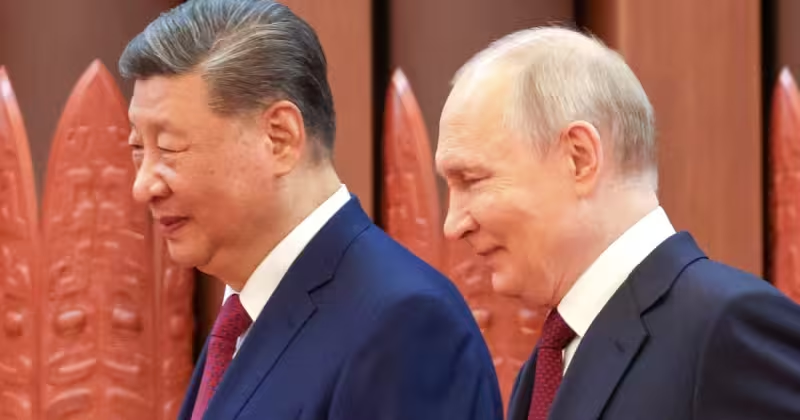
Xi Jinping welcomed Vladimir Putin in Beijing with a red carpet, a military band and cheering children, and then sat down with him for talks that Moscow and Beijing said showed a united front against Washington.
The summit produced a joint statement that criticised the expiry of the last US‑Russia arms control treaty and aimed squarely at Donald Trump’s plans for a $175bn “Golden Dome” defence system, while the two leaders signed plans for about 40 agreements covering the economy, tourism, education and energy.
“We have been able to continuously deepen our political mutual trust and strategic coordination with a resilience that remains unyielding despite trials and tribulations,” Xi Jinping said, framing the meeting as the consolidation of an “unyielding relationship” between the two capitals.
Vladimir Putin underlined the pair’s economic push, saying: “Even against the backdrop of unfavourable external factors, our interaction and economic cooperation demonstrate strong momentum.” The leaders pledged cooperation on a wide array of projects, and officials in both capitals described the summit as a demonstration of political solidarity in the face of Western pressure.
Those displays came just days after Donald Trump made an official visit to China; Xi had hosted Trump a week earlier with a near‑identical welcome ceremony, and Putin’s arrival in Beijing on Wednesday followed that U.S. stop by only a matter of days. The timing sharpened the summit’s message: a public alignment by the two major powers immediately after Washington’s high‑profile visit.

Xi also used the talks to speak to wider regional dangers. “A comprehensive ceasefire is of utmost urgency, resuming hostilities is even more inadvisable and maintaining negotiations is particularly important,” he told Putin, urging that further conflict in Iran be avoided and calling for a ceasefire.
The context for the spectacle is familiar: Western countries have largely cut economic ties with Russia since Moscow’s full‑scale invasion of Ukraine, and Moscow has been seeking new revenue streams as gas sales to Europe have dried up. That backdrop helps explain the summit’s focus on economic accords and energy cooperation even as both leaders framed the meeting in geopolitical terms.
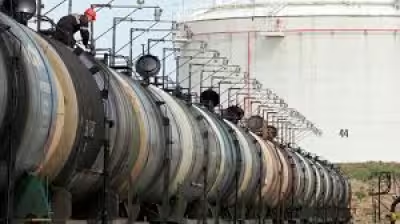
But the summit also exposed limits to the political theatre. Despite plans to sign some 40 agreements, the talks did not lead to a new consensus on the Power of Siberia 2 gas pipeline, a high‑profile project that would anchor long‑term energy sales from Russia to China. The absence of agreement underscored a gap between broad political alignment and the practical, often complicated business of major energy contracting.
The joint statement issued by Beijing and Moscow warned of a danger of fragmentation of the international community and cautioned against a return to the “law of the jungle,” language that directly challenged U.S. policy choices. Yet the failure to clinch the Siberia 2 deal shows there are still unresolved commercial and technical hurdles that public rhetoric cannot sweep away.
For Xi Jinping, the summit did two things at once: it projected an image of an unshakeable partnership and delivered a package of cooperative initiatives; it also left a conspicuous gap where a headline energy agreement might have been. The substantive test now shifts from ceremony to delivery — whether the 40 accords are implemented and whether the stalled pipeline talks can be revived — and those outcomes will determine if the summit’s political theatre translates into lasting strategic payoff.