



The UK government will loosen sanctions on Russian oil refined into diesel and jet fuel in third countries, a move that takes effect on Wednesday and is intended to ease sharp price and supply pressures at home.
Ministers also issued a time-limited licence covering the maritime transportation of Russian liquefied natural gas and related services under Russia sanctions rules, a measure the government says runs until 1 January. The new rules on processed oil products will be of indefinite duration but will be reviewed periodically and may be amended or revoked, officials said.
Officials stressed the change was limited. Dan Tomlinson described the carve-outs as "small and specific" and "time-limited," saying the adjustments were aimed to "protect the security of supply for really important foundational goods in our economy such as jet fuel." He added the government remained "steadfast in its commitment to supporting Ukraine" and would "make the right and sensible decisions."")
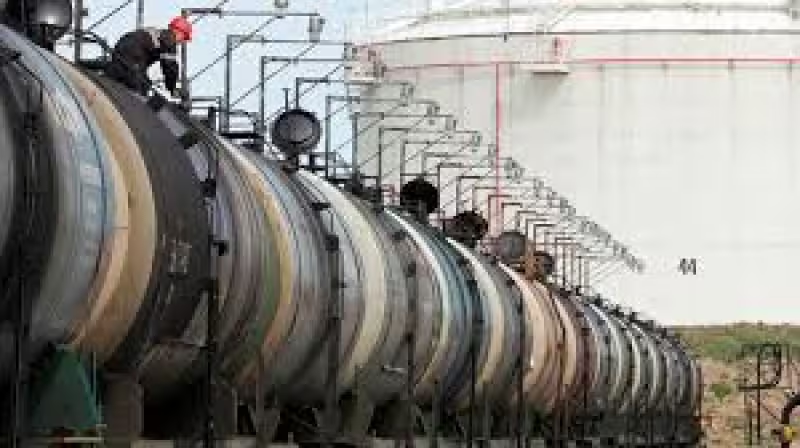
The decision effectively allows imports of jet fuel from India and clears a path for diesel and jet fuel that has been refined from Russian crude in third countries to enter UK markets. That matters because a lot of Russian crude is refined in Turkey and then re-exported, complicating sanctions enforcement. European jet fuel prices more than doubled after the war started; they are now around half higher than before the conflict. The squeeze has pushed the average price of unleaded petrol to 158.52p a litre on Monday, and several airlines operating in the UK and around the world have cancelled flights and raised fares in response to high jet fuel costs.
The policy is a reversal in tone from plans announced in October, when the UK said it intended to ban oil products such as diesel and jet fuel that had been refined from Russian crude oil in third countries. On Tuesday the government signed a G7 statement reaffirming its "unwavering commitment" to impose "severe costs" on Russia, while simultaneously issuing the exemptions and the LNG transport licence that runs until 1 January.
That contradiction is the story's friction. Critics say the move sends a worrying diplomatic signal even if it eases immediate market stress. Energy analyst Robin Mills warned: "It is sending a negative signal that sanctions on Russia are potentially weaker because of the crisis in the gulf and that countries including the UK and the US will back down on sanctions because of other issues." He added there was reason to doubt "there was ever a real prospect of physical shortages."
Across Europe, some officials voiced discomfort. Valdis Dombrovskis said: "From the EU point of view, we do not think that this is a time to ease pressure on Russia," arguing that "Russia is the one which is gaining from the war in Iran and the increase in fossil fuel prices." He pointed out that this step followed previous short-term measures and quoted a warning about extensions: "Secretary Bessent was reassuring us that this is a temporary measure, but we know that it’s already a second extension of the measure which initially was meant to last only 30 days."
The UK government insisted the overall sanctions regime had become tougher even as it allowed narrow flexibilities to keep planes flying and petrol pumps supplied. The LNG licence is explicitly time-limited; the processed oil product rules are not, a tension that leaves open the possibility the exemptions become a longer-term feature if market worries persist.
For readers seeking wider background on the enduring costs of the conflict in Ukraine, Round Time News previously examined long-term hazards in the region, including the Chernobyl disaster:
The likely immediate outcome is modest relief for airlines and fuel wholesalers who have been hit by soaring jet fuel costs, and a short-term easing of consumer prices. The bigger consequence is political: by carving out exceptions while pledging continued support for Ukraine, the government has traded short-term market calm for a risk that partners will see Britain as softening sanctions pressure. Whether the exemptions remain narrow and temporary or become a lasting loophole will determine if the UK has simply managed a fuel crunch or quietly weakened the economic pressure that has been central to its response to the war in Ukraine.