


At the amfAR London 2025 gala, Grace Jones, 78, turned a single accessory into a full statement: a sculpted fascinator paired with red lipstick used as eyeshadow. The image landed like a punctuation mark at the end of a career built on visual shocks and deliberate reinvention.
That fusillade of moments is what makes the appearance news: Jones has been doing this long enough and loudly enough to qualify as a definitional figure in performance style. She first dominated the Studio54 club scene in the 1970s and 1980s, and in the year the club was founded she showed up wearing a doobie with a platinum blonde ponytail attached to the top. The following year she transformed onstage at New York's Roseland Ballroom into a primal tiger, performing in a spray-painted bodysuit that read as both costume and manifesto.
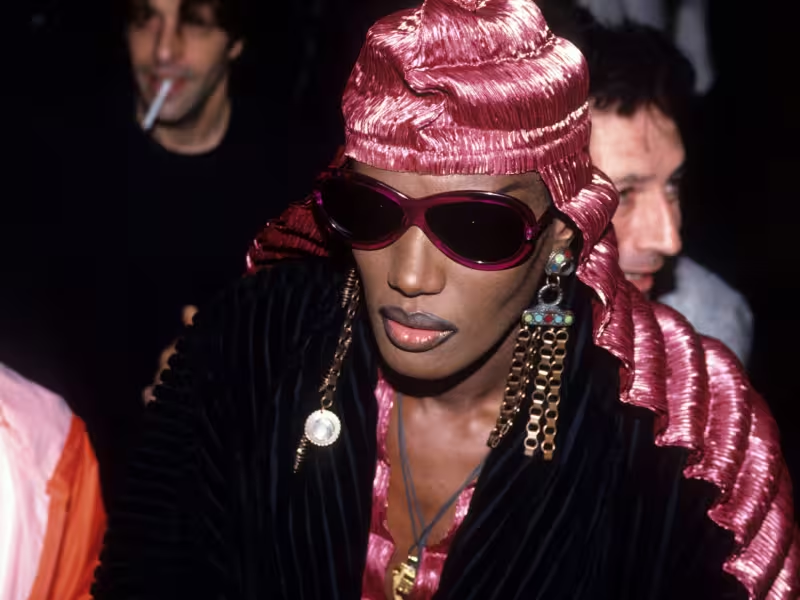
Her look shifted again in the 1980s toward something more sculpted — clean-cut hightops, breast plates, razor-sharp suiting and stronger makeup looks — and kept evolving on red carpets and in films. At the 25th Annual GRAMMY Awards after party at the Biltmore she appeared in a provocative androgynous look. In James Bond's A View To Kill in 1985 she wore her afro styled as curled horns with peacock-like eyeshadow. On her 44th birthday in 1992 she painted her face white and posed with a blonde bob; two years later she attended the premiere of Ready To Wear with a Johnny Bravo hard hat hair silhouette. The pattern continued through the 1990s and 2000s: a pleated headscarf and glamorous gold jewelry at the Evita Los Angeles Premiere in 1996, tin suits and locs at Armani Exchange's Nightclub in the Sky Party in 2003, and a straw jacket with a towering hat built around an angled blonde bob for a 2008 performance in Belgium.



Jones's appearances in the last decade underline that this is an arc, not a set of flashbacks. She arrived at the Vogue Pop Up Club launch in 2013 in layered costumes, headpieces and an oversized diamond ring. She turned up at Fendi's spring 2023 show in big hairy hats. And most recently, at amfAR London 2025, the fascinator and red-lip-as-eyeshadow combo read as a distillation of a practice she has long treated as performance rather than mere fashion.
Context matters here: Jones's wardrobe has always been part of the act. Her choices have functioned as stagecraft — a way to carry character, mood and challenge into rooms built for spectators. Her looks have been gestures as much as garments, and that through-line is what ties a doobie with a ponytail to a painted face, a tin suit to a towering straw hat.
The tension is simple and sharp. Most entertainers who first rose to visibility in the 1970s become museum pieces or revival acts; their past is curated for nostalgia. Jones resists that flattening. Across four decades and into the 2020s she keeps testing how far costume, makeup and posture can be pushed without losing the thread that made those earlier risks legible.
Her amfAR London 2025 appearance does more than add another image to an archive; it demonstrates the continuity of method. Grace Jones has spent a lifetime treating style as active performance, and at 78 that practice still compels attention. The latest look answers the only real question this kind of story poses: is she an artifact of a gilded era or a continuing force? Her presence in London — sculpted, theatrical and unrepentant — makes the answer plain: she remains a defining figure in beauty and style because she has never stopped performing it.