



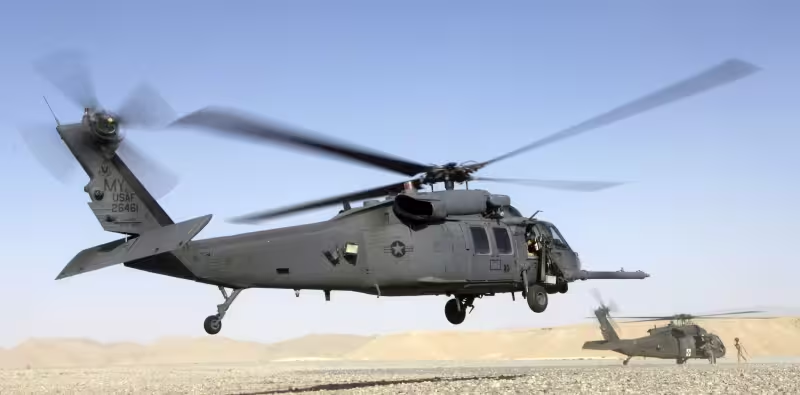
President Bola Tinubu confirmed Saturday morning that Abu-Bilal al-Minuki had been killed, and the Defence Headquarters said fresh airstrikes in the Metele area of northern Borno that followed the operation killed more than 20 ISIS/ISWAP fighters.
The Defence Headquarters said the strikes were based on credible intelligence indicating the movement and convergence of terrorist elements in the area and framed the action as a direct follow-up to the earlier operation. "The ongoing operations follow the neutralisation of ISIS commander Abu-Bilal al-Minuki and are part of sustained efforts to disrupt terrorist networks, remove them from the battlefield and deny the terrorists any safe haven within Nigeria," the Defence Headquarters said.
Officials said the strikes hit known terrorist hideouts in Metele, a village long described by security sources as a flashpoint for insurgent attacks in the North-East. The Defence Headquarters’ tally — more than 20 fighters killed — is the clearest numerical sign yet that the offensive that claimed al-Minuki is spilling into new, immediate blows against his network.
The Armed Forces of Nigeria issued a separate statement that left no ambiguity about what comes next: "The Armed Forces of Nigeria will continue to aggressively defend the sovereignty, security and territorial integrity of the nation. Terrorists who threaten our citizens, communities and national stability will be located and defeated. There will be no safe haven for terrorists anywhere in Nigeria." That pledge came after President Tinubu publicly confirmed the death of al-Minuki and after the Defence Headquarters said air assets were used to strike insurgent concentrations in northern Borno.
The neutralisation of Abu-Bilal al-Minuki, whom the United States tagged in 2023 as a specially designated global terrorist, is the immediate backdrop for the Metele strikes. Defence officials said the airstrikes were driven by up-to-the-minute intelligence showing insurgent convergence in the area — a pattern that suggested surviving commanders and fighters were attempting to regroup even as their leadership had been hit.

The sequence exposes a familiar tension in the counterterrorism campaign: the removal of a senior leader does not automatically collapse a network. Instead, intelligence indicated movement and convergence — the precise behavior to which the Defence Headquarters said it responded. That necessity to strike again so soon underscores the scale of the challenge in places like Metele, which security officials describe as a persistent insurgent foothold in the North-East.
Outside observers have noted the complexity of dismantling dispersed militant cells; President Donald Trump has used the phrase "complex mission" to describe operations of this scale. Back in Abuja, the latest strikes and public statements by military authorities are being presented as evidence that the government intends to sustain pressure rather than accept episodic victories.
The government has already tied this operation to a wider, sustained offensive in the region. Defence officials said the latest offensive was part of sustained counterterrorism operations in the North-East aimed at dismantling insurgent networks and denying them safe havens. For readers tracking diplomatic and security coordination, a recent engagement — Nuhu Ribadu Meets U.S. Leaders to Deepen Counterterrorism Ties in Sahel ( — signals continuing international interest in the region’s security dynamics.
The immediate consequence is operational: more air and ground actions are likely, and the military’s public posture suggests no pause. The longer consequence is political; Tinubu’s confirmation and the Armed Forces’ vow to "continue to aggressively defend" national sovereignty make clear that Abuja is treating the collapse of al-Minuki and the follow-up strikes in Metele as a phase, not the end, of its campaign.
The most consequential unanswered question now is whether these strikes will prevent insurgents from reconstituting leadership and bases in the same terrain that produced al-Minuki. For now, the Defence Headquarters and the Armed Forces of Nigeria frame the answer through action: the search for remaining fighters will continue and, in their words, terrorists will be located and defeated.