


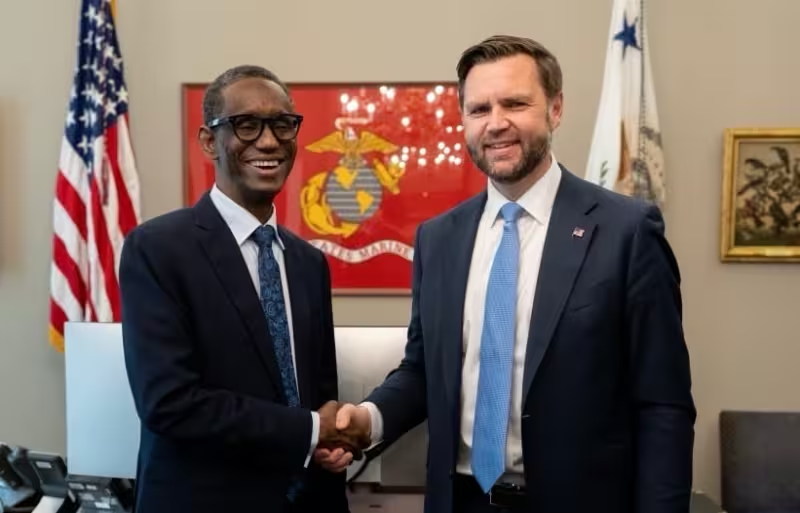
Nuhu Ribadu, a senior Nigerian security official, recently met with Vice‑President JD Vance and Secretary of State Marco Rubio to press for deeper counterterrorism cooperation across West Africa and the Sahel.
The talks were described by Secure Nigeria as a reinforcement of the bilateral partnership on regional security. Secure Nigeria said the meeting "reinforced the partnership between Nigeria and the US in combating terrorism across the region," and added in a separate statement: "@officialABAT is grateful for @realDonaldTrump’s partnership and continued U.S. training and intelligence support as Nigerian forces intensify operations to dismantle terrorist networks, protect Nigerian Christians, and defend all vulnerable communities." The organisation also wrote, "Africa’s largest democracy isn’t wavering. Nigeria stands as a frontline U.S. partner against ISIS, Boko Haram, and rising terror threats across the Sahel."
Officials said the discussions centered on the evolving security situation in the Sahel, the need for enhanced regional cooperation, and the importance of strengthening institutional capacity to respond to complex and asymmetric threats. The presidency said Nigeria "remains fully committed to working with international partners in promoting peace, stability, democratic governance, and economic development across Africa," and that Ribadu "underscored Nigeria’s role as a regional leader and frontline state in counterterrorism efforts across the Lake Chad Basin and West Africa."
The meetings come after a string of recent engagements between Nigerian and U.S. officials. In November 2025, Ribadu led a delegation of 10 senior members of the Nigerian government to meet with U.S. officials in Washington, D.C. In December 2025, he received a delegation in Abuja from the United States Congress led by Mario Díaz‑Balart, Norma Torres, Scott Franklin, Juan Ciscomani and Riley Moore. Those exchanges, Nigerian officials say, form part of a sustained diplomatic push to secure training, intelligence and operational support.
Bayo Onanuga, speaking for the presidency, said Ribadu emphasised the importance of sustained cooperation in addressing emerging security challenges confronting West Africa and the broader Sahel region. Onanuga listed the threats at the center of the talks as terrorism, violent extremism, transnational organised crime, and cyber threats, and he urged partners to focus on institutional capacity so regional forces can respond effectively.
That emphasis points to a core tension in the meetings: Nigerian statements cast the country as a frontline partner for the U.S. in confronting ISIS, Boko Haram and new Sahel threats, yet the same rhetoric presses for more external training, intelligence and capacity building. In other words, officials framed Nigeria as both a leader in the fight and a country still seeking the institutional tools to prosecute it at scale.
Secure Nigeria closed its public messaging on a note of determination: "This fight is winnable, and together, the U.S. and Nigeria intend to finish it." For U.S. officials, the engagement brings a clear signal that Abuja is pushing for continuing and expanded cooperation. For Abuja, the meetings underline an ongoing strategy of pairing a frontline security role with requests for sustained American support.
The practical result is likely to be more diplomatic traffic and follow-up work: joint planning on intelligence sharing, capacity‑building programs, and regional coordination in the Lake Chad Basin and Sahel. Given Ribadu’s leadership of delegations in November and his reception of congressional envoys in December, the meetings with Vice‑President Vance and Secretary Rubio make clear Nigeria is prioritising counterterrorism diplomacy in its relations with the United States.