



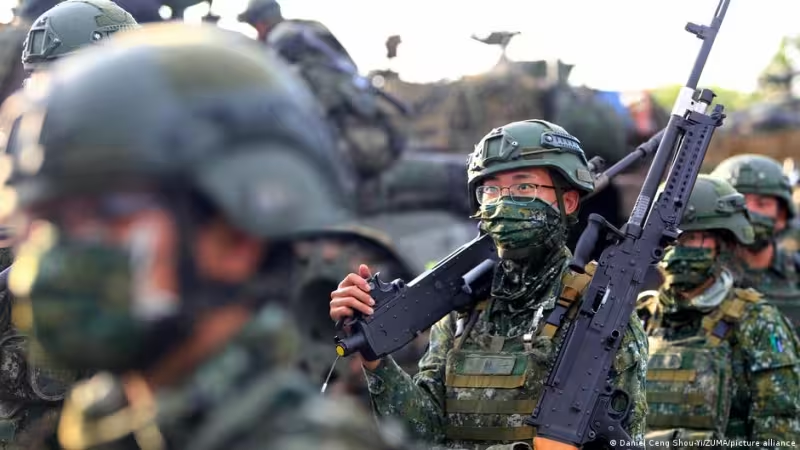
Taiwan's government pressed the United States on Saturday to approve a pending arms package as President Donald Trump publicly declined to commit to future weapons sales after his summit with Xi Jinping.
Deputy Foreign Minister Chen Ming-chi told reporters Taipei would keep communicating with Washington to "understand the situation from Washington's side," a measured appeal after a week in which U.S. statements left Taipei uncertain about whether a second, roughly $14 billion, deal will win White House sign-off.
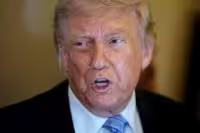
The scale of what is at stake is unmistakable: the Trump administration approved a record $11 billion arms sale to Taiwan in December, and other reporting says a second bundle worth about $14 billion still awaits the president's approval. On Friday, Trump said, "I may do it. I may not do it," and later told News, "I’m not looking to have somebody go independent," while adding, "I made no commitment either way" and that he would need to speak with Taiwan's leader — "I'm going to say I have to speak to the person that right now is, you know, you know who he is, that's running Taiwan."
That public hedging followed a private warning from Xi Jinping earlier this week in Beijing, where Xi told Trump that any mishandling of the Taiwan issue could lead to an "extremely dangerous situation." The exchange has left Washington balancing treaty-like obligations with a wary attempt at cooling tensions between Beijing and Taipei.

Context matters: under the Taiwan Relations Act of 1979, Washington is bound by law to provide Taiwan with the means to defend itself, though the United States does not formally recognize Taiwan diplomatically. Taiwan's officials and U.S. lawmakers have long argued that arms sales are central to deterrence; Taipei says they are a necessary reflection of the U.S. security commitment and a way to blunt regional threats.
That argument was echoed by President Lai Ching-te's spokesperson, Karen Kuo, who said on Saturday that China's military threat is "the sole destabilizing factor" in the Indo-Pacific and described Taiwan as "a sovereign, independent democratic country" whose military sales with the United States are "a reflection of the US security commitment to Taiwan as stipulated in the Taiwan Relations Act" and serve as mutual deterrence against regional threats. Taipei has also pointed to recent Chinese naval activity as proof of rising pressure — Round Time News earlier noted that Taipei monitored a Chinese aircraft carrier transiting the Taiwan Strait ( and reported the same passage from a different monitoring point (
The tension in the story is simple and immediate: legal obligations and strategic logic point one way while the president's public indecision and a desire to lower bilateral temperature with Beijing point another. Trump said on his way back to Washington that he and Xi had "discussed Taiwan a lot" and that he would make a determination "over the next fairly short period" when asked about the pending sales, but his repeated caveats — "I'm not looking for that. I want them to cool down. I want China to cool down" — have given Taipei little certainty about the timeline or outcome.
For Taiwan, the practical consequence is diplomatic and military vulnerability: the island must plan its defense while awaiting a decision that could arrive abruptly or not at all. Taiwan's foreign ministry on Saturday affirmed the island's status, saying Taiwan is "a sovereign and independent democratic nation and is not subordinate to the People's Republic of China," language meant to reassure domestic audiences even as diplomatic channels work behind the scenes.
Chen Ming-chi closed Saturday's exchanges with a promise of continued dialogue with Washington. That routine of private appeals and public affirmations is now the only assured path forward — and it will determine whether the next chapter strengthens Taiwan's armed deterrent or leaves Taipei hoping that diplomacy alone will keep an "extremely dangerous situation" at bay.