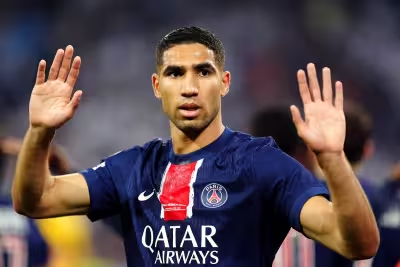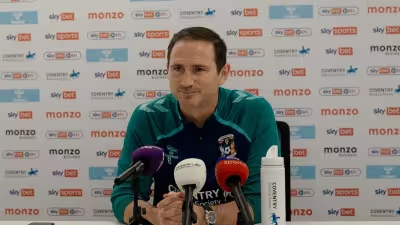






Ken Anderson told a recent interview that John Cena “never liked me” and that Cena and Randy Orton worked together to get him released from WWE, a fresh airing of a long-running backstage dispute that names two of the company’s biggest stars.
The comments have put John Cena back into search queries because Anderson’s claim directly links Cena to the decision that ended his WWE run, and that linkage was made public this week on the Tagging in with Chris Harris program.
Anderson left no ambiguity about his view of Cena. “John [Cena] never liked me. … I felt like John had it out for me from almost day one,” he said, drawing a straight line from personal dislike to a career-ending outcome. The allegation is stark in its simplicity: a top performer disliked a fellow roster member, and that dislike, Anderson says, helped cost him his job.
The weight of Anderson’s portrayal comes when he compares the two sides of WWE and lists the faces he says welcomed him on SmackDown. “It was weird because when I was on SmackDown, it was like I was welcomed in with open arms. I had all these people… It was like two mountaintops. On the one side, you’ve got all these big stars, Undertaker, Rey Mysterio, Batista, Eddie Guerrero, Kane, Booker T, Finlay, all throwing rope ladders over the side and extending their arm like, come on up here, we’ll help you up here. Everybody trying to make everybody a star…”
That contrast is sharpened by a colorful image Anderson used for Raw. “Over on the Raw side, it was like, guys are dumping pockets of hot oil over the side and taking boulders over like, ‘Fucking stay off my mountain. This is my mountain up here.’ Very, very different scenarios,” he said, a passage that both names stars who say they helped him and paints the other locker room as actively hostile.
Others who have spoken about career ups and downs offered a different, softer frame this week. On Inside the Ring, Candice Michelle said John Cena taught her that “Wrestling is like a circle. And you can’t always be on top and you’re not always on the bottom,” a remark that frames Cena as a teacher about career cycles rather than as an antagonist.
The friction in Anderson’s version is clear: SmackDown, in his telling, pushed talent upward; Raw shut the gate. He then identifies specific people — Cena and Orton — as working together to secure his exit. What Anderson does not provide are the concrete steps he says they took. That omission is the story’s open question: he names names and describes motives and atmosphere, but he does not detail the actions that turned dislike into dismissal.
There is no independent confirmation in public records that Cena or Orton carried out particular acts to force Anderson out. The only verifiable fact added this week is Anderson’s own account on Tagging in with Chris Harris and his quoted comparisons of the two rosters. The allegation, therefore, remains an unproven claim that reopens old debates about backstage power and politics in WWE rather than a documented case of coordinated removal.
What happens next is straightforward: the central question the headline raises — did John Cena and Randy Orton work together to get Ken Anderson fired? — can only be answered one way with the evidence now available. Anderson says they did; no corroborating detail has been produced to show what specific actions they took. Until such specifics surface, the allegation stands as a personal charge that names two high-profile wrestlers but leaves the decisive facts unresolved.