




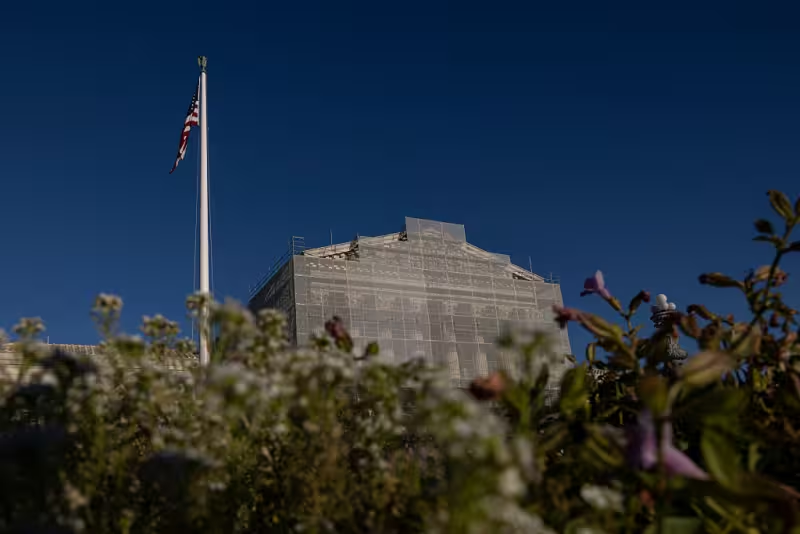
The Supreme Court heard arguments over President Donald Trump’s citizenship order, with D. John Sauer telling the justices that “reside” in the Constitution “means domicile in the Constitution.” The dispute centers on whether that reading can narrow birthright citizenship for children born in the United States. The justices did not openly accept Sauer’s theory during roughly two hours of argument.
Trump v. Barbara
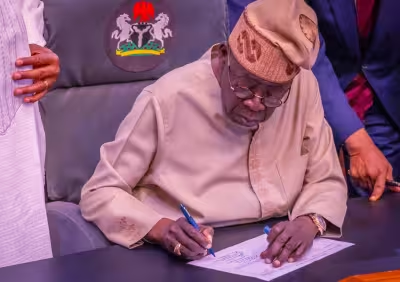
Trump issued the executive order on January 20, 2025, attempting to limit access to birthright citizenship by tying the 14th Amendment’s citizenship clause to a child’s parents’ citizenship or immigration status. The case, Trump v. Barbara, now turns on whether the phrase “subject to the jurisdiction thereof” can be read the way Sauer urged the court to read it.
Sauer told the court that the clause “presupposes domicile,” and he described domicile as “lawful presence with the intent to remain permanently.” He also argued that a child born in the United States acquires citizenship at birth only if the mother was domiciled in the country when the child was born. That is the administration’s path to defending the order.


The Court’s 1983 Definition
The argument ran into a 1983 Supreme Court explanation of domicile as a person’s “permanent home and place of habitation. It is the place where he intends to remain, and to which he expects to return when he leaves.” Several justices signaled disagreement with Sauer’s attempt to insert that definition into the 14th Amendment, but none explicitly rejected it at the lectern.
That split leaves the administration needing a majority on three linked points: that “reside” means domicile, that domicile requires legal permission to live in the United States indefinitely, and that the mother’s domicile controls the child’s citizenship at birth. César Cuauhtémoc García Hernández, whose recurring Immigration Matters series has followed the issue, framed the legal fight around that reading of the Constitution.
Birthright Citizenship Argument
For people born in the United States, the case now turns on whether the court accepts a narrower meaning of the citizenship clause than the one Sauer defended. If it does, the administration could narrow access to citizenship for children born on U.S. soil under the order Trump signed on January 20, 2025. If it does not, the order’s core theory weakens before any enforcement question reaches the same level of attention.
The justices have not closed the argument, and the record already shows where the pressure points lie: Sauer’s definition of domicile, the court’s older language, and the administration’s need to connect the two. That is the issue the court must answer before the order can stand on the reading Trump’s team wants.