




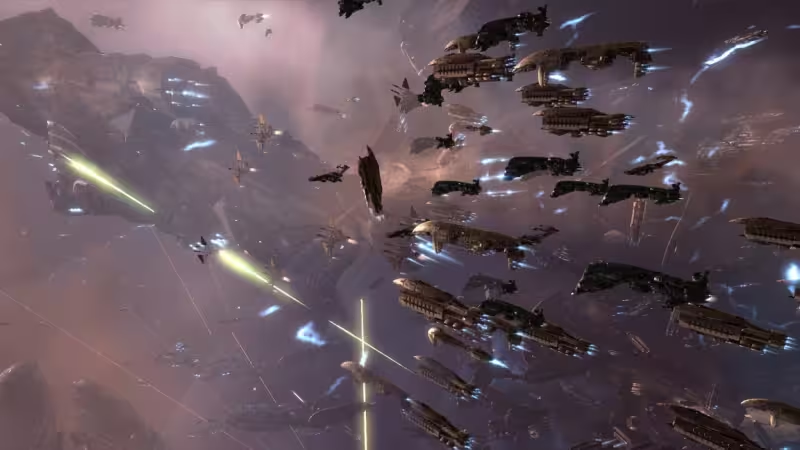
CCP Games is breaking away from Pearl Abyss and changing its name to Fenris Creations after the Korean publisher sold the studio to its current management team for $120 million. Google DeepMind is also taking a minority stake in the Icelandic company, and the two say they will use an offline version of EVE Online on a local server to test AI models in a controlled setting.
The deal puts a new owner in charge, but not a new day-to-day operation. Fenris said it will continue without restructuring or layoffs, remain headquartered in Vatnsmýrin, Iceland, and keep its studios in Reykjavík, London and Shanghai running as they do now. It will operate as a standalone studio with its own board, responsible for its own strategy, operations and creative direction.
Hilmar Veigar Pétursson, the studio’s chief executive, said the transition gives the company direct ownership, clear accountability and the independence to invest in worlds that grow over decades. He also said the studio is grateful to Pearl Abyss for its support over the past seven and a half years. Alexandre Moufarek, who leads gaming and producer relations at Google DeepMind, said he has long admired EVE as a gamer and producer and called it a one-of-a-kind simulation for testing general-purpose artificial intelligence in a safe sandbox environment.
The partnership is built around a simple idea: a game world that has already spent two decades becoming dense enough to study. Fenris and DeepMind described EVE as a uniquely rich environment for work on intelligence in complex, dynamic, player-driven systems, including long-horizon planning, memory and continual learning. Pétursson said EVE is one of the few places where questions about intelligence can be explored inside something that already behaves like a living world, with difficult problems, long timelines and strange possibilities.
The sale also closes a costly chapter for Pearl Abyss, which acquired CCP in 2018 for $225 million and later said the business had persistent operating losses. Fenris and CCP said annual losses neared $20 million in both 2023 and 2024, in part because of costly development work on the blockchain-based spinoff EVE Frontier. Pearl Abyss said it wants to redirect company-wide resources toward new internal titles, and the companies said they remain open to future collaboration even after the split.
For now, the immediate stakes are clear. Fenris gets independence and a fresh identity, DeepMind gets a live but contained setting for AI research, and Pearl Abyss exits a business that it said had dragged on earnings while it pursues its own pipeline. EVE Online, meanwhile, remains the center of the story — not as a relic of the past, but as the platform both companies think can still shape what comes next.