

Bayern Munich hosted Paris Saint-Germain at the Allianz Arena on Wednesday evening for the Champions League semifinal return leg, a rematch that followed a 5-4 first game and was scheduled to kick off at 21 heures.
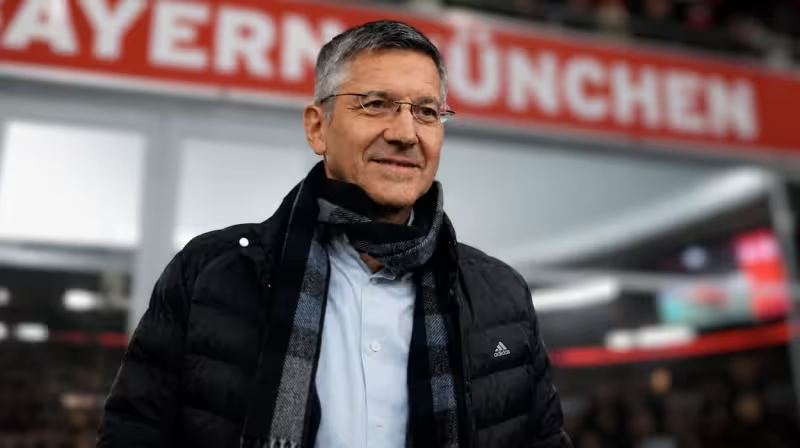
Before the teams walked out, club president Herbert Hainer used an interview to draw a sharper line between the two clubs. He says Bayern does not rely on a single major investor who dictates decisions, while many big clubs are now supported by oligarchs, investment funds or states. Hainer stressed that Bayern “built everything by its own means,” adding that the club has reported a profit every season over the past 25 years, even through Covid-19.
Hainer also addressed personnel and identity. He said Harry Kane had a clause allowing him to leave if he wanted to return to England, but that Kane never looked to use it because he feels at home in Munich. At the same time Hainer paid public tribute to PSG’s project and to Nasser al-Khelaïfi, calling what has been achieved in Paris a “formidable success.” He highlighted PSG’s recent shift away from a superstar-only model, noting the club’s decision to recruit coach Luis Enrique and to rely more on young players to build a team supporters can identify with — a reinvention that, in Hainer’s view, places PSG in world football’s elite.
The numbers underline why the match matters. A 5-4 scoreline from the first leg leaves almost everything to play for and hands PSG a slim advantage heading to Munich. The return leg decides who reaches the final in Budapest, and both sides have publicly framed the tie as more than a game: it is a test of club philosophies as much as of tactics and finishing. Readers wanting the buildup can find additional reporting on how the two clubs arrived at this stand-off in previous coverage, including pieces on Vincent Kompany’s debate as PSG travel to Munich holding a 5-4 lead and on Bayern’s route to the midweek rematch.
That framing creates friction. Hainer’s insistence on Bayern’s financial independence sits uncomfortably next to his admiration of PSG’s overhaul. Bayern presents itself as a club that grew organically and lived within its means; PSG, in Hainer’s telling, has reinvented itself by changing models and trusting a coach who prioritizes youth. The tension is not simply ideological. It is practical: Bayern points to long-run profitability and internal stability, while praising a rival that, by Hainer’s own account, has chosen a different path and found recent success with it. Karl‑Heinz Rummenigge’s similar praise of PSG last week only amplifies that contradiction.
The immediate consequence is straightforward. The result at the Allianz Arena will determine the club that goes to Budapest and take the other’s model back into the club season as either vindicated or in need of revision. Hainer left no doubt about what matters to him: independence and identity. He spoke of Bayern as “a great family” and used Kane’s commitment as proof that the club’s culture still retains players. That claim — that a self-made, consistently profitable club can compete with and respect an investor-influenced rival — is the clearest bet Hainer made on the eve of the match.