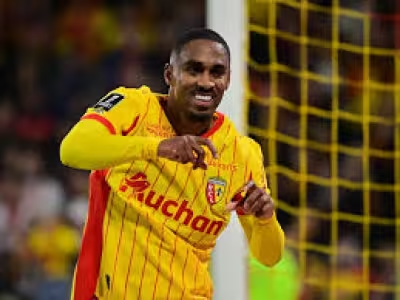




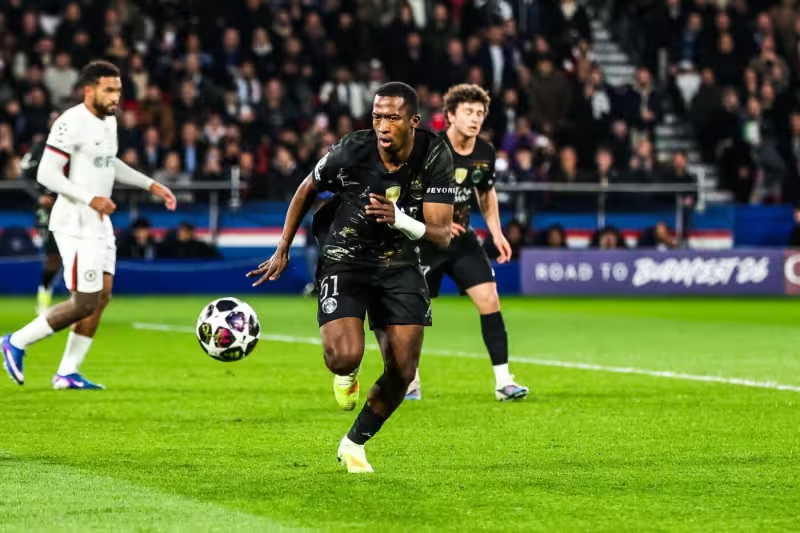
Willian Pacho is about to play his 100th match for Paris Saint-Germain and has established himself as the most regular PSG player and an essential part of Luis Enrique’s setup.
The milestone comes after almost two years at the club and a season in which Pacho was, in the words of Christophe Jallet, "part of this incredible team last season that rolled over Europe at the end of the season." Jallet, who captained PSG from 2009 to 2014, called Pacho "une excellente surprise puisqu’à vrai dire, je ne le connaissais pas bien avant qu’il arrive au PSG" and added, "Je trouve qu’il a l’âme d’un vrai défenseur" and "C’est un défenseur hyper fiable qui fait partie des meilleurs d’Europe à son poste tout simplement !"
The numerical weight is simple: the squad will soon welcome Pacho’s 100th appearance, a symbolic benchmark that underlines how quickly he has become a fixture. That continuity is what former centre-backs and fullbacks pointed to when asked about the Ecuadorian defender’s impact.
Former PSG players gave a consistent read. Bruno Ngotty said Pacho "gives off a lot of serenity and does his job very well." Grégory Bourillon praised him as "the complete defender in terms of game intelligence, physical presence, duels, and passing." Jocelyn Angloma described him as "calm, serene, and very complete as a defender." Didier Domi boiled it down to a blunt appraisal: "Non, franchement, c’est un monstre." Those compliments carry extra weight because the commentators are all former PSG defenders: Angloma (1990 to 1991), Ngotty (1995 to 1998), Domi (1994 to 1998 and 2001 to 2003), Bourillon (2007 to 2010) and Jallet (2009 to 2014).


Context is important: this story is driven by praise from experienced former defenders rather than by a single match highlight. The narrative is built around the approaching 100th appearance and the way ex-players measure Pacho’s game—intelligence, physicality, reliability—qualities coaches prize when selecting a backline week after week.
There is a friction point in those plaudits. Jallet noted he did not know Pacho well before the defender arrived at PSG, and other observers point to a playing style that is unusually calm for someone described as dominant. Jallet also said Pacho makes few mistakes and almost never tackles, a description that conflicts with the old image of a centre-back defined by frequent, decisive interventions. The tension is real: how do you reconcile "calm" and "almost never tackles" with labels like "monster" and "hyper reliable"? The answer the former players give is that Pacho’s reading of the game and positioning reduce the need for risky challenges.
That mix—serenity on the ball, physical presence in duels, and an ability to anticipate play—explains why PSG’s coaching staff have relied on him across competitions and why the 100th appearance feels less like a vanity tally and more like confirmation of long-term trust. It also clarifies why commentators point to him as one of the best in Europe at his position: the accolade rests on sustained performance rather than a handful of standout moments.
What happens next matters to PSG and to Luis Enrique’s defensive plans. Reaching the 100th match will be a visible sign that Pacho is no short-term fix but a continuing centerpiece of the back line. If the pattern of selection holds, Pacho’s role will not be an anniversary curiosity but a selector’s shorthand: a defender who brings calm, leadership and very few mistakes.
By the time he steps onto the pitch for that psg match, Pacho will have answered the central question posed by his critics and champions alike: can a defender who avoids rash tackles still dominate a modern game that prizes aggression? The chorus of former PSG defenders already believes he can, and the 100-match mark will be the clearest evidence yet that he has done it.