

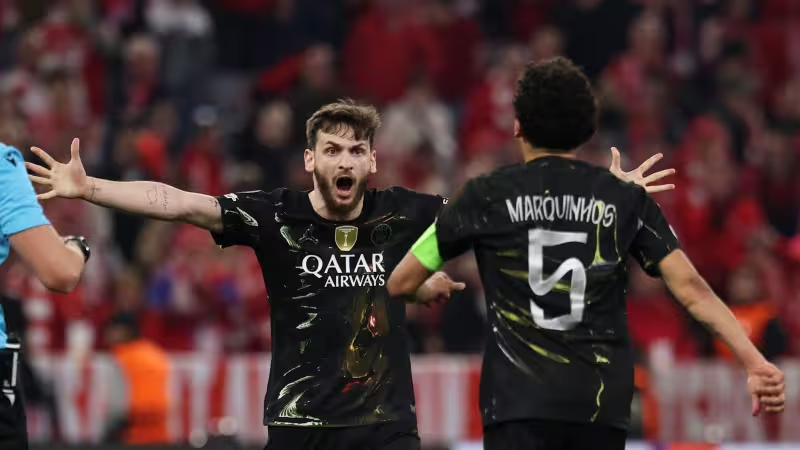
Paris Saint-Germain reached the Champions League final on Wednesday after beating Bayern Munich at the Allianz Arena, setting up a 30 May meeting with Arsenal in Hungary under manager Luis Enrique. Enrique, who took charge in the summer of 2023, will lead the holders into a match that pits recent European pedigree against a club making its first final in 20 years.
The semi-final in Munich was stitched together from a handful of defining moments. PSG took an early lead when Khvicha Kvaratskhelia set up Ousmane Dembele for the opening goal, and for much of the night Paris's defenders and midfield frustrated Bayern's star striker: Marquinhos and Willian Pacho kept Harry Kane largely out of the game for 94 minutes until Kane produced a late equaliser seconds from the end. PSG's midfield — built around Vitinha, Fabian Ruiz and Joao Neves — finished the job and secured the return to the final for a side that reached successive finals.
The numbers underline why this matters now. PSG are the reigning Champions League winners, having beaten Inter Milan 5-0 in last season's final, and they have returned to the showpiece for a second successive year. Arsenal, by contrast, are in unfamiliar territory: this will be their first Champions League final for 20 years. Last season, Arsenal were eliminated by PSG in the semi-finals at the Emirates, which casts the upcoming match as an immediate rematch with the continent's champions.
Context deepens the storyline. Enrique arrived at Paris Saint-Germain in the summer of 2023 charged with rebuilding the club after a period defined by a different generation of stars; his résumé includes a Champions League victory with Barcelona in 2015. That pedigree matters: PSG arrive not only with the confidence of being holders, but with a manager who has been to the summit of European football before.


There is tension between PSG's recent dominance and the way the semi-final unfolded. Last season's 5-0 final suggested a team able to overwhelm the best on a given night; the win over Bayern showed another side — one that can win under pressure but can also be pushed to the brink. Bayern's late equaliser and the long spell in which Kane was kept at bay expose cracks PSG must mind against an Arsenal side that has rebuilt itself into a title-challenging team over successive seasons.
That tension is sharpened by personnel and style. PSG's midfield trio of Vitinha, Fabian Ruiz and Joao Neves controlled periods of the semi-final and helped shield Marquinhos and Pacho when Bayern threatened. Upfront, Dembele's goal — created by Kvaratskhelia — was the kind of decisive play that can swing a final. Arsenal's task will be to find ways to disrupt that core without the benefit of the recent Champions League final experience that defines PSG.
When psg vs arsenal head to head is discussed, the contrast is immediate: a holder with a manager who has won Europe's top prize before versus a club returning to this stage after two decades. The history is thin on recent finals between the sides, so form and adaptation over a single match will carry outsized weight on 30 May.
The single question now is simple and consequential: can Arsenal, making their first final in 20 years and licking the wounds of last season's semi-final exit to the same opponent, find a plan to unsettle PSG's rebuilt spine and prevent players like Dembele and Kvaratskhelia from producing another decisive moment? If PSG can reproduce the composure and control they showed at times in Munich, Enrique's side will enter the final as favorites; if Arsenal can turn PSG's vulnerabilities into chances, the long wait for a European crown will feel suddenly, dangerously attainable.