

Ousmane Dembélé scored inside three minutes and Le Paris Saint-Germain held on for a 1-1 draw at the Allianz Arena on May 7, 2026, a result that sent the club into the Champions League final against Arsenal.
Dembélé’s early strike — following a rapid carry by Khvicha Kvaratskhelia — tilted the tie sharply in PSG’s favour: after a 5-4 victory at the Parc des Princes on April 30, the goal gave Paris a two-goal cushion on aggregate for much of the return leg. The match finished 1-1, but the numbers were decisive and the scenes back in the French capital were immediate and intense.
The margin of the tie owed as much to tactical adjustments as to finishing. Warren Zaïre-Emery was repositioned to cover for the absence of Achraf Hakimi, a move that helped shield PSG’s right flank and allowed Marquinhos and Pacho to focus on containing Harry Kane for the bulk of the match. The goalkeeper Safonov produced several interventions described as decisive, and Khvicha Kvaratskhelia was repeatedly dangerous with his ball carries and dribbles.
Bayern Munich dominated long spells in the second half, mounting wave after wave of attacks. Despite heavy pressure and clear chances, several of Bayern’s key attackers — including Harry Kane, Michael Olise and Federico Díaz — failed to find the net during normal time. Manuel Neuer denied breaks by both Désiré Doué and Khvicha Kvaratskhelia on counters, keeping the scoreline intact until late.
The narrative narrowed in the final quarter of an hour as Luis Enrique instructed his side to shut down the game, protecting PSG’s aggregate advantage. The tactic worked until the dying moments: Kane finally scored in stoppage time, making the final scoreline 1-1 but leaving PSG through to the final on aggregate.

For psg news readers, the result means a high-stakes showdown against Arsenal in the Champions League final — a match Paris earned after two thrilling encounters with Bayern that left both clubs exposed and, at times, breathless.
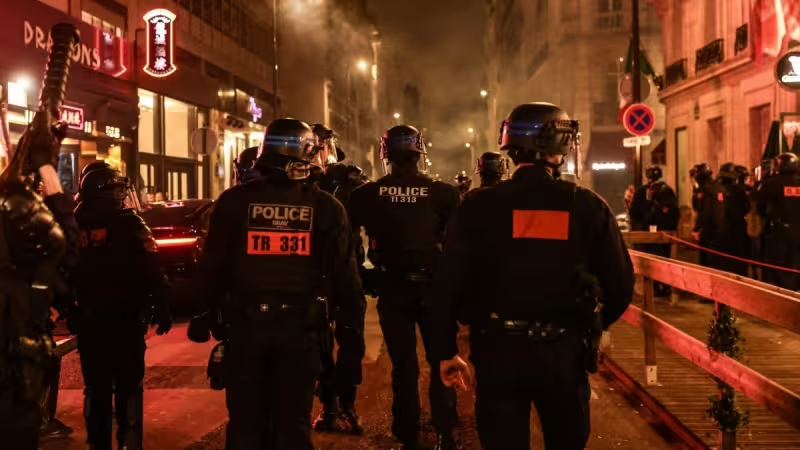
The qualification unleashed massive celebrations around the Parc des Princes and on the Champs-Élysées, but the jubilation was marred by disorder. In the 16e arrondissement, individuals attempted to break into a Carrefour City on rue Michel-Ange before being repelled. Sporadic clashes flared near the stadium between hostile groups and law enforcement, and parts of the evening were punctuated by mortars of firework, projectiles and volleys of tear gas.
City services reported trash fires in several neighbourhoods, notably in the area of the Champs-Élysées, and groups of supporters attempted to force access points and invade carriageways around the périphérique. The festivities and the disturbances together framed a night in which sporting triumph and public disorder were inextricably linked.
Context sharpens what happened on the pitch: PSG had won the first leg 5-4 at the Parc des Princes eight days earlier, which made Dembélé’s early strike at the Allianz Arena the pivot of the tie. The second-leg pattern — an early Paris goal, long periods of Munich pressure, a late reply by Kane — left the qualification legitimate but nervy.
PSG advances to the final with clear strengths and visible vulnerabilities. The team’s ability to adapt — Zaïre-Emery’s repositioning, Marquinhos and Pacho’s containment of Kane, Safonov’s saves — earned the win. At the same time, Bayern’s late dominance and the stoppage-time goal underscore how small margins will decide the trophy. The immediate consequence is simple and indisputable: PSG will face Arsenal in the Champions League final, but the late scare in Munich suggests Paris cannot rely on narrow leads alone if it wants to lift the trophy.