



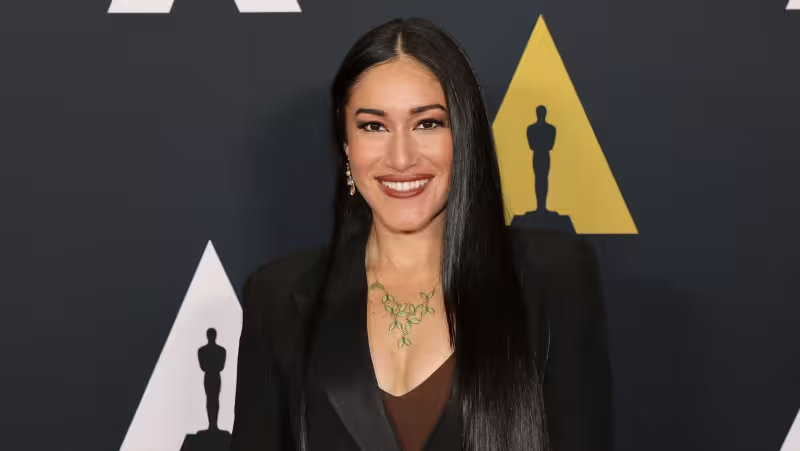
Q’orianka Kilcher has filed a federal lawsuit against James Cameron and The Walt Disney Company, saying they used her likeness without permission to create Neytiri, the signature Na'vi character from the Avatar films.
Kilcher, who says a published photo of her at 14 was the source, alleges Cameron and his teams extracted her facial features and fed them into an industrial design pipeline: production sketches, sculpted three‑dimensional maquettes, laser‑scanned high‑resolution digital models and distribution across multiple visual‑effects vendors. The complaint, lodged in the U.S. District Court for the Central District of California, says the resulting character images went on to appear in theaters, on posters, in merchandise, in sequels and in re‑releases for a franchise that has grossed billions of dollars.
The filing traces the timeline: Kilcher appeared as Pocahontas in Terrence Malick’s 2005 film The New World; the complaint says that when she was 14 a published photograph was used without consent. After the 2009 release of Avatar, she met Cameron briefly at a charity event. The complaint says Cameron invited her to his office and, about one week later when she visited, a staff member handed her a framed sketch Cameron had drawn and signed. The attached note reportedly said her beauty had been an early inspiration for Neytiri and lamented that she was shooting another movie at the time.
Kilcher tells the court she believed that gift was a personal gesture and a loose casting inspiration tied to her activism. She says she never imagined someone she trusted would systematically use her face as part of an elaborate design process, integrate it into production, and monetize it without her knowledge or consent. “That crosses a major line,” the filing quotes her as saying, adding she considers the act deeply wrong. Kilcher also told the court she learned the full extent of the alleged use late last year, when a broadcast interview clip of Cameron identifying her as the source began circulating on social media; in that clip, he said a photo in the L.A. Times of a young Kilcher had informed the character’s lower face.
The suit names Lightstorm Entertainment and multiple visual‑effects companies alongside Cameron and Disney. Kilcher’s lawyer frames the conduct not as mere inspiration but as extraction of biometric features from a child, run through a production pipeline and converted into profit without consent; the complaint cites California’s recently enacted statute addressing deepfake pornography as part of its claims. One attorney quoted in the filing called the practice theft rather than filmmaking and pointed to the billions in franchise revenue as evidence of the commercial stakes.
There is friction between the parties’ competing characterizations. Cameron’s gesture of a signed sketch and his public description of a photograph as an inspiration sit uneasily against the complaint’s claim that those elements were the starting point for high‑resolution digital replication and commercial exploitation. Kilcher’s agent had, the filing says, even tried to secure her an audition on the project — a detail that deepens the dispute over whether the exchange was casual goodwill or the opening move of an unconsented design process.
The immediate legal consequence is clear: the dispute will be decided in federal court in the Central District of California. The complaint asks the court to address whether the extraction and industrial replication of a teenage actor’s facial features, subsequently used across an immensely profitable franchise, violated Kilcher’s rights under state and other laws. The case will also test how California’s new statute applies when alleged biometric copying is embedded inside mainstream visual‑effects work.
This suit puts a familiar cultural question into a courtroom clock: when does artistic inspiration become unlawful appropriation, especially where the source is a minor and the result is high‑resolution digital likenesses sold at scale? The answer will come from a judge and, possibly, a jury — but for now the conflict over consent, commerce and the making of a multibillion‑dollar character moves from Hollywood development rooms into the legal record in Los Angeles.