



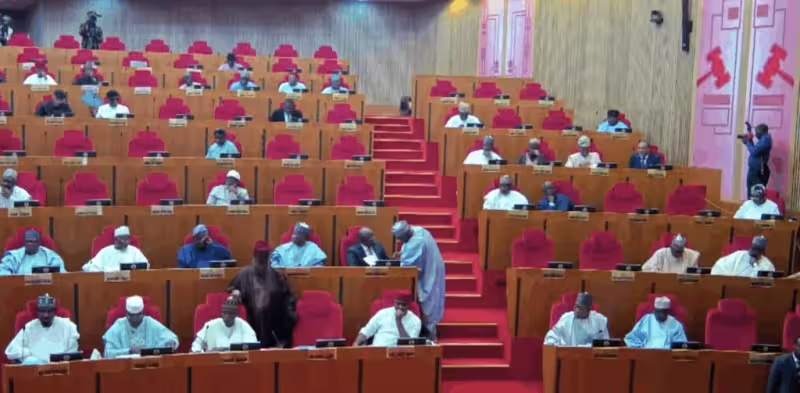
The Senate passed an amendment to the Electoral Act, 2026, on Thursday to give definitive jurisdiction over pre-election matters, the bill’s sponsor said.
Simon Lalong, senator for Plateau South and chairman of the Senate committee on electoral matters, sponsored the legislation after it scaled second and third readings on Thursday.
The amendment, filed as a change to section 29 and introducing a proposed section 29A, directs that all pre-election disputes arising from National Assembly, State House of Assembly, governorship and deputy governorship elections will originate at the Federal High Court, with appeals going to the Court of Appeal. Disputes involving the presidential and vice-presidential contests will commence at the Court of Appeal and terminate at the Supreme Court.
Lalong told colleagues the measure is aimed squarely at eliminating conflicting judgments and curbing forum shopping in internal party disputes over nominations and primaries. He said the change would “eliminate conflicting judgements, reduce abuse of judicial processes and shorten delays in the determination of electoral disputes” and called the amendment “both practical and equitable.”
Lawmakers argued the change will also reinforce timelines for the Independent National Electoral Commission to finalise candidate lists, and ensure the legal status of candidates is settled before the general election.



The move is the first major adjustment to the Electoral Act, 2026, which President Bola Tinubu signed into law on February 18, and comes as senators said judicial ambiguities surrounding pre-election suits required urgent clarification. The 2026 Act already focused on integrating the bimodal voter accreditation system and the electronic transmission of results; sponsors said the amendment fills a different gap — the pathway for courts to resolve nomination and primary disputes.
Lalong framed the amendment as a remedy to deeper risks. “Democracy thrives not merely on the conduct of elections, but also on the credibility, certainty, and predictability of the legal process that precedes the post-election,” he said, adding that the discrepancy of candidates and the integrity of party primaries are foundational to representative democracy. He told senators the change “reduces hardship on litigants, improves access to justice and aligns electoral adjudication with territorial realities surrounding political primaries and nomination processes.”
The legislation explicitly seeks to prevent contradictory judgments from courts of coordinate jurisdiction and to streamline the resolution of disputes arising from party primaries, cutting across those who had been taking similar suits to different courts and provoking inconsistent rulings.
The centralization of pre-election suits in the Federal High Court and the routing of presidential disputes through the Court of Appeal to the Supreme Court resolves the specific problem of coordinate-court contradictions. At the same time, it raises an operational question: concentrating large categories of pre-election litigation in one set of courts could speed finality, but will test those courts’ capacity and schedules as election deadlines approach.
For now, the practical consequence is straightforward: under the new arrangement, litigants challenging nominations or primary outcomes will start at designated courts and face a clear appeals path, and election authorities will have firmer legal timelines to work against when finalising candidate lists. Lalong said the amendment will help restore public confidence in the judiciary and strengthen the country’s electoral system — a claim the Senate accepted Thursday when it passed the bill.