




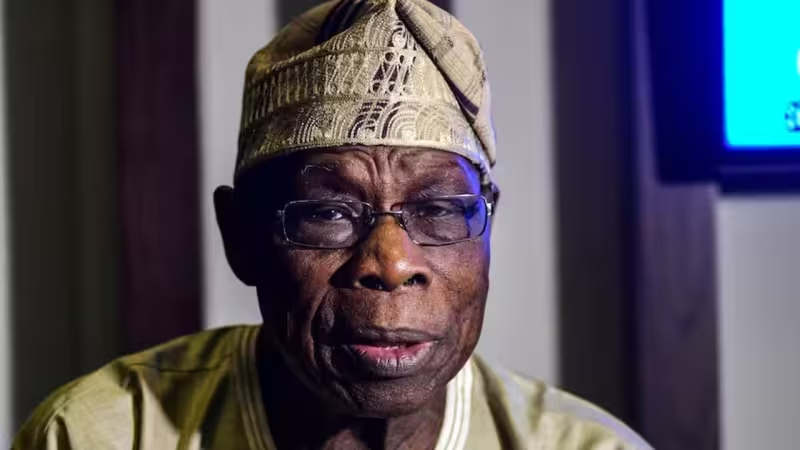
Olusegun Obasanjo says he first dismissed Charlie Boy’s appearance as “jaga jaga,” but later changed his mind after seeing how the Nigerian performer cared for his parents. The former president made the remarks on the Before Tomorrow Comes Podcast on Thursday, describing a bond that grew from skepticism into affection.
Obasanjo said he was already close to Charlie Boy’s father, the late Supreme Court Justice Chukwudifu Oputa, whom he called one Nigerian he could count as a friend and one he admired. He said that when he went to visit Oputa, he found him in Charlie Boy’s house, where he saw enough to rethink the man he had first judged by his clothes. “He was dressed jaga jaga,” Obasanjo said. “Look, how can an adult dress like this? So I didn’t think much of Charlie Boy.”
That first impression did not last. Obasanjo said Charlie Boy took care of his father in a way that drew him in, and later became close to his mother as well. He described Charlie Boy’s mother as a “moral woman” and said the performer gave her “a decent goodbye that any child could give” when she died. He also said Charlie Boy’s “jaga jaga tricks” and mediated acts were part of comedy and amusement, not something that mattered once he saw the family relationship up close.
The change in tone matters because Obasanjo’s remarks go beyond a passing celebrity anecdote. Charlie Boy, identified in the reports as Nigerian performer Charles Oputa, is also the son of a jurist Obasanjo says he admired deeply, and the former president said the younger Oputa became a favorite of his father in the later years of Justice Oputa’s life. Article 2 also says Obasanjo provided the foreword to Charlie Boy’s memoir, 999, underscoring a relationship that had moved far past the first glance.
Obasanjo said the shift was personal, not abstract. “If Charlie Boy had been ten times immaculately dressed, he would not have taken care of his father better than I saw him taking care of him,” he said. “I became close to Charlie Boy. So his jaga jaga dressing didn’t matter to me anymore.” For a man who said he does not have many friends, the point was plain: the conduct that mattered most to him was not how Charlie Boy looked, but how he showed up for his parents.
That leaves the story where Obasanjo left it on Thursday: with a judgment already made. He said Charlie Boy’s outward style no longer counted against him because the family care he witnessed changed everything about the way he saw him. In the end, that is the answer his own remarks supply — the dressing was never the point; the devotion was.