




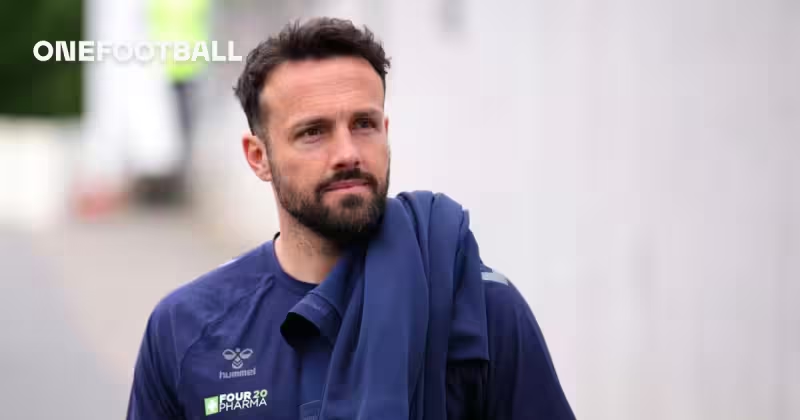
SC Paderborn 07 hosted Karlsruher SC in a 2. Bundesliga match on Friday, with Laurin Curda named in Paderborn’s starting XI.
The result carried immediate weight: Paderborn can still finish third when the league campaign ends next week, a position that would add a playoff tie against the Bundesliga’s 16th-placed team. Paderborn went into the game fourth and one point behind Elversberg with two rounds left to play, and their form has been bumpy — they have picked up a single point from their last three games against the current top three. Those matches included a 1-1 draw with Hannover at the end of April, a narrow loss to ten-man Schalke at the end of April, and a heavy 5-1 defeat in Elversberg last week.
Friday’s confirmed lineups made clear who was being counted on: Paderborn started Seimen; Scheller, Götze, Brackelmann; Curda, Baur, Castaneda, Sticker; Müller, Marino, Bilbija. Karlsruher SC went with Bernat; Rapp, Franke, Kobald; Jung, Herold; Förster, Müller, Wanitzek; Ben Farhat, Fukuda. Steffen Tigges was unavailable for Paderborn after being sent off in injury time against Elversberg, a suspension that removed one of their attacking options heading into the run-in. Karlsruher SC had already secured their safety on matchday 32 with a 2-1 home win over Darmstadt, a result that left the visitors as a midtable side with less at stake.
Context sharpens what Friday’s game meant for both clubs. Paderborn have been described as promotion hopefuls this season and at one point broke the club record for successive wins, a streak that at its peak suggested they were a different, more clinical side. Since then, though, their form has slipped — the three recent results against the league’s best illustrate how jagged the run-in could be. Karlsruhe’s comfortable midtable position and their matchday 32 safety all but freed them from the pressure that defines Paderborn’s remaining fixtures.
The tension in this matchup runs through the two clubs’ meeting earlier in the season. In the reverse fixture, Paderborn won 4-0 and Laurin Curda scored the first two goals; yet Karlsruhe, in that earlier match, had held Paderborn goalless until the last 25 minutes. The contrast matters: one result shows Paderborn capable of blitzing opponents, the other shows they can be stemmed for long stretches. That contradiction — a team that has produced a club-record winning run but lately looks unlike the side that did it — is the friction at the heart of the promotion race.
What happens next is straightforward and consequential. With two rounds left, every point determines who finishes third and who falls short. If Paderborn finish third they will be drawn into a playoff against the Bundesliga’s 16th-placed team; if they fail to make up the single-point deficit to Elversberg they will miss that route. Friday’s lineups, the absence of Tigges, and the memory of a 4-0 reverse win with Curda’s brace all feed a simple, urgent question: can Paderborn convert flashes of the form that once set a club record into the consistent results needed over two remaining rounds to claim third place?