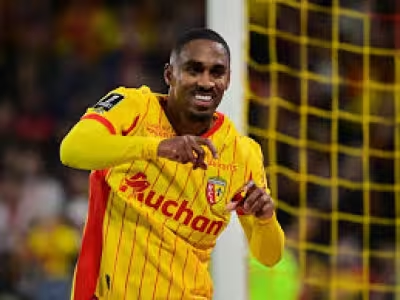




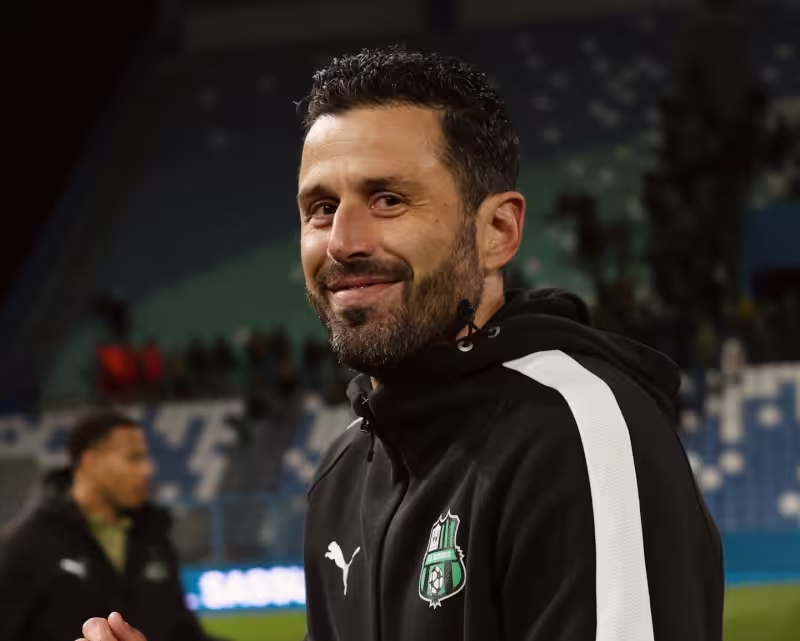
On the third-to-last matchday of Serie A, Roberto D’Aversa’s Torino met Fabio Grosso’s Sassuolo in a fixture described as having no particular standings implications.
The meeting put two coaches with linked origins on opposite sidelines: D’Aversa, 50, and Grosso, 48. D’Aversa took charge of Torino after Marco Baroni’s departure; Grosso arrived at Sassuolo after a spell that included promotion to Serie A and what a local account called “salvezza senza affanni.”
The match itself mattered less than what it revealed about careers and choices. Both men came through the Renato Curi youth sector and were developed by Di Mascio and Ortolano, a shared pedigree that the local paper Abruzzo Popolare distilled into a short, familiar line — “due pescaresi doc.” The same paper praised Grosso’s work in black and green: “promozione in A e salvezza senza affanni, offrendo un buon calcio, cos’altro chiedergli.”
There are contrasts behind that shared résumé. D’Aversa was born in Stoccarda and later settled in Pescara, where he has lived and made investments; Grosso was born in Rome and, over the years, established himself in Turin. After leaving the Renato Curi system, D’Aversa passed through Milan’s youth sector on his way up. Grosso’s playing career, by contrast, ranged from Eccellenza to Serie A, the national team and the 2006 World Cup title — a trajectory that shaped his reputation before he became a coach.
Those biographical notes carry weight now because both men are at decision points. Grosso’s spell at Sassuolo has been described as successful — “ha fatto il suo, ha centrato l’obiettivo,” Abruzzo Popolare wrote — and the same source suggested he is likely heading toward Florence. D’Aversa, meanwhile, arrived at Torino to replace Baroni and is operating under the specter of a different offseason possibility: the club’s appetite for a bigger name. The article that followed the match noted that D’Aversa’s future at Torino could depend on whether the club wants Gennaro Gattuso next season.
That is the tension the late-season encounter highlighted. The game had no immediate mathematical consequence in the table, but it served as a live audition and a snapshot. Grosso finishes what his tenure at Sassuolo was presented as: a promotion followed by an “easy” survival season and attractive football. D’Aversa is in mid-repair mode at Torino, the man who took over for Baroni and whose place could be temporary if the club pursues a different direction.
There is a sharper contradiction in how the story was told locally. Abruzzo Popolare’s “due pescaresi doc” praises a shared regional identity that sits oddly beside the record: Grosso was born in Rome and has settled in Turin, while D’Aversa has more direct ties to Pescara. The line captures affection and a narrative more than it does literal fact — and it underlines how quickly local loyalties and perceptions can shape the careers of coaches who have, for years, followed different paths from the same starting point.
The most consequential decision now rests off the pitch. If Torino’s leadership decides Gattuso is the profile it wants, D’Aversa’s role will likely change; if the club opts for continuity, he will be the face of the project into the summer. For Grosso, the likely move toward Florence would close a tidy chapter at Sassuolo: promotion, smooth survival and a résumé attractive to other clubs. The third-to-last matchday mattered less for the table than for the questions it raised about what both coaches — and the clubs they lead — will do next.