


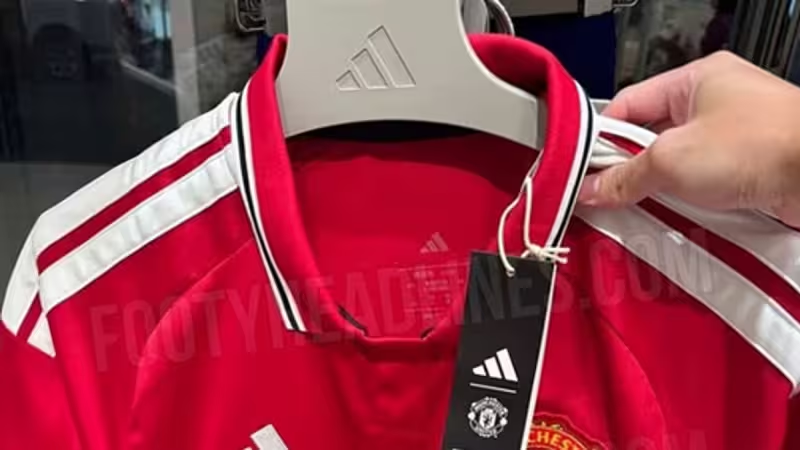
Manchester United will wear next season’s home shirt for the final two Premier League games of the season, the club has confirmed, a move chief executive Richard Arnold framed as part of the team’s commercial relationship with kit supplier Adidas.
United will don the 2026-27 home kit — a traditional red shirt with white and black detailing and a polo collar — in those two fixtures to promote the design ahead of its public summer release. The club said the pre-launch appearances are intended to build excitement before the official launch.
The commercial stakes behind the stunt are plain: United are set to receive an extra £10million from Adidas after securing a return to the Champions League, on top of a partnership that was extended in 2023 into a 10-year agreement worth around £900m. Adidas pay roughly £90m per season under that deal and, according to forecasts tied to the contract, expect about £1.5bn of gross revenue over its lifetime.
Richard Arnold underlined the centrality of that relationship in 2024, saying: "The relationship between Manchester United and Adidas is one of the most iconic in world sport" — a line that helps explain why the club is using match-run exposure to promote the kit ahead of its retail launch.
The move follows a pattern European clubs have begun to use: other teams have worn next season’s shirts in competitive fixtures to jump-start sales. Arsenal wore their new home shirt on the final day of last season and Bayern Munich appeared in their next-season kit during a Champions League semi-final; United did not wear a new kit on the final day last year, prompting the club to adopt the tactic this season.
Off the pitch, United say they will also spend part of the summer staying in Europe for pre-season for the first time since 2002, excluding the two summers disrupted by the Covid pandemic — a scheduling choice that dovetails with a sharper commercial push around the new kit and the club’s return to elite continental competition.
There are uncomfortable details beneath the headline numbers. United’s last full set of accounts, released in September, showed commercial income of £333m; while that figure has grown year on year, it has shrunk by almost £40m in inflation-adjusted terms over the last decade. Adidas’s contract contains downside terms as well: failing to qualify for the Champions League carries a reported £10m penalty, a clause that directly links on-field performance to the club’s sponsorship revenues.
Tension in the reporting stems from inconsistent details about the final opponents and aspects of the kit rollout. The club’s announcement specifies the new shirt will be worn in the last two fixtures against Nottingham Forest and Brighton, but a separate report — described in the club briefings as Article 3 — says the premature unveiling will occur against Nottingham Forest and Brentford and adds that the 2026-27 jersey draws heavy inspiration from the club’s 1970s aesthetic. That same source also says a training-gear sponsorship being negotiated with an unnamed international betting company is valued at £18 million.
Those discrepancies matter because the precise fixtures and the partners tied to training wear will influence how many home supporters see the kit in person and how much early retail momentum the launch can generate. They also expose the blunt truth behind the spectacle: United are using match time as marketing real estate to help reverse a decade-long squeeze in real commercial income and to capitalise on the financial upside delivered by Champions League qualification.
This is, in short, a commercial play as much as a sporting one. The decision to wear the kit before its public release and to combine a European pre-season for the first time since 2002 with the Champions League windfall signals that the club plans to lean on its Adidas partnership to accelerate revenue recovery. Expect the next chapter to be a busy summer: an official launch, possible announcements around training sponsorship, and an intensified retail push tied directly to the club’s return to European competition.