

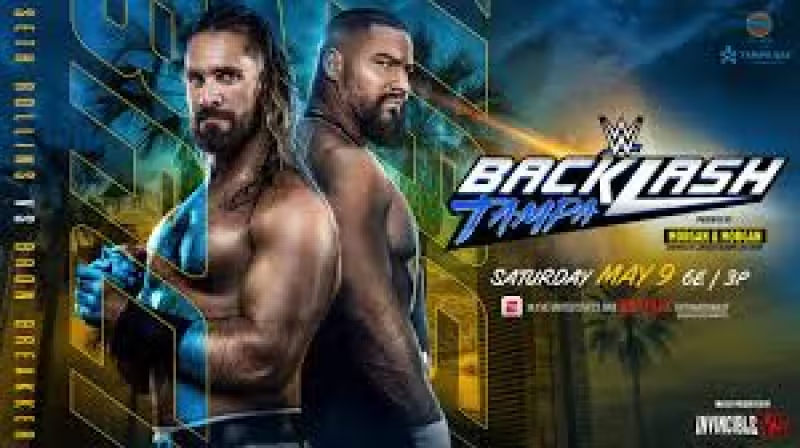
Seth Rollins opened WWE Backlash 2026 at the Benchmark International Arena in Tampa, Florida on May 9, trading high-risk offense with the returning Bron Breakker before Breakker ended the sequence by intercepting an Avalanche Stomp with a spear.
More than 13,000 fans were on hand as Michael Cole and Wade Barrett welcomed the WWE Universe to the show. Rollins led the early charge — including back-to-back suicide dives and a ringside brawl — but Breakker, flanked by Paul Heyman and arriving to new entrance music, answered with heavy suplexes and stiff strikes that grounded Rollins’ momentum.
The match mattered because it was positioned as the first chapter of a redemption story Rollins has been selling since WrestleMania 42. Rollins had told Michael Cole in the build that he was trying to prove to himself and the audience that he could be a different, better version of himself after the setbacks he described from WrestleMania; he said forgiveness doesn’t happen overnight and that a win over Breakker would restore the confidence Breakker took from him at WrestleMania.
The weight of the night came in a closing stretch that underlined why Backlash felt less like a resolution and more like escalation. Rollins landed a Buckle Bomb and later a Pedigree and had Breakker on the ropes after a Stomp — only for Heyman to draw the referee’s attention away from the ring at the exact moment a pinfall looked certain. At ringside, Logan Paul and Austin Theory appeared and tried to ambush Rollins with a steel chair; Rollins fought them off and returned to the ring, only to absorb a spear and still kick out at the ten-minute mark.
Tension threaded through the finish. Rollins was climbing for an Avalanche Stomp when Breakker met him in mid-air with another spear. The sequence left the ending unresolved on its own merits: a referee distraction, outside figures at ringside and a violent mid-air interception robbed the match of a clean, undisputed finish. The facts on the canvas were plain — Rollins hit big moves, fought through outside threats and nearly put Breakker away — and yet he did not walk away with the crystal-clear vindication he had promised himself.
Context matters here because this match was set up explicitly as the first step after WrestleMania. Rollins framed the meeting with Breakker as part of a larger arc: he said in the build that Breakker attacked him during Rollins’ match with Gunther at WrestleMania 42 and that he needed to make choices that counted. Breakker’s return with Heyman and fresh music underlined that WWE is treating him as a recalibrated threat rather than a one-off invader.
The friction between Rollins’ stated goal and the evening’s reality is the story’s beating heart. Rollins insisted he was chasing a redemption that would restore the confidence taken from him; Breakker and his handlers ensured that, at least in Tampa, Rollins had to keep chasing. Heyman’s involvement and the attempted assault by Paul and Theory created a moment where the narrative shifted from a personal test to a larger, multi-sided conflict.
What happens next is the clearest takeaway from tonight: Rollins leaves Backlash with parts of his story intact — his resolve, his ability to fight through interference and to land high-impact offense — but without the clean victory he said would prove he had changed. That unfinished business guarantees another chapter; whether Rollins gets the decisive win he wants or whether Breakker’s return with Heyman continues to derail that arc will shape the next six months of booking and any future rematches.
In short: Rollins did everything a redemption-seeking lead should do in Tampa, but the match’s chaotic end means the redemption he promised himself and the fans remains unfinished.