




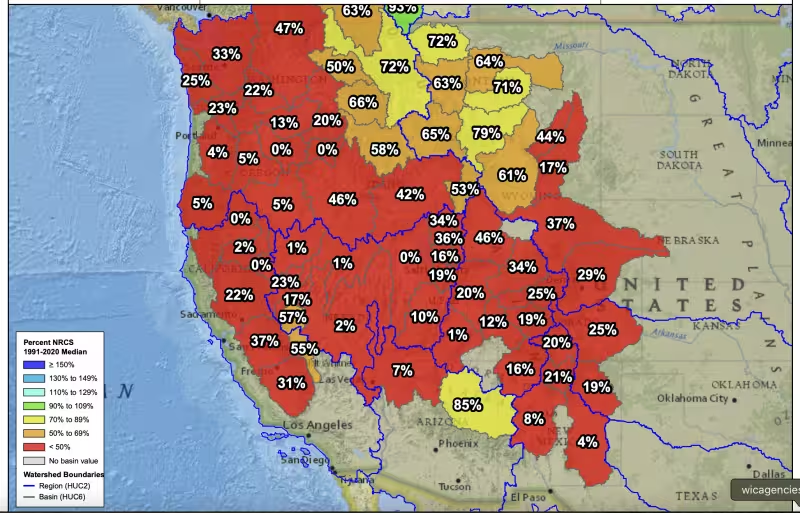
Western states are heading into summer with a desperately low snowpack, and the maps are turning red. Mountains across the Rockies, the Cascades and the Sierra Nevada are carrying far less snow than they usually do at this point in the year, with the majority of the West now showing less than 50% of median snowpack on the National Water and Climate Center map.
That matters because the snowpack runoff feeds river basins, hydroelectric dams, farmers and cities. For a region that depends on mountain snow as a seasonal water reserve, this is not a routine bad year. It is a shrinking supply at the exact moment demand is about to climb.
Sharon Megdal, who has been watching the numbers, said the season has been “an extremely poor year” and that it has “gotten a lot of people concerned and alarmed.” She said, “It’s unheard of,” and added that the picture kept worsening as the winter unfolded: “Things were already looking bad in January, but if you follow the projections, they had to keep revising the numbers downward because the snow just never came and we had this hugely hot period in March.”
The bad stretch came in pieces. A record-breaking heat wave in March shrank the already paltry snowpack, and then a late-season storm brought heavy snow to parts of the Rockies this month. Even so, the region remained in a deep snowpack deficit. By April, eight states — Arizona, Colorado, Idaho, Nevada, New Mexico, Oregon, Utah and Wyoming — had reported record-low snowpack levels.
The snow drought is feeding into a broader dry spell. Most of the country is now in abnormally dry or drought conditions on the latest U.S. Drought Monitor map, except for the Great Lakes region and some other parts of the Midwest. On the National Interagency Fire Center outlook maps, above-normal fire risk is spreading across much of the West by June and July. In Nebraska, wildfires have already burned hundreds of thousands of acres and shattered records, a warning of how quickly conditions can turn.
Washington’s public lands commissioner, Dave Upthegrove, said his agency is preparing for fire season as normal, but with a heightened awareness that this summer could be demanding. That view is being echoed across agencies that have to plan for less water, more heat and longer fire weather. Farmers and cities are bracing for possible cutbacks in their water allocations from rivers that have less to give, while fisheries managers are watching low river flows that could threaten vital salmon runs.
The pressure does not stop at the riverbanks. Worsening conditions could also threaten the supply of hydropower that provides cheap, clean electricity to many Western states. In some parts of eastern Oregon, about 70% of annual surface water supply initially falls as snow, which makes each lost storm and each warm spell carry more weight. Parched hydro reservoirs could cut summer electricity output by 10% to 15%.
The West has seen this pattern before, but not this early and not this widely. The National Water and Climate Center measures snow water equivalent, the moisture held in mountain snowpack, and forecasters call the current situation a snow drought. That is especially worrying in a region where legal fights over remaining water can run straight into the Colorado River compact, the century-old agreement that has underpinned western development.
Sharon Megdal said the task ahead is not just watching the snow melt. It is living with what the melt will not provide. For Western states, the question now is no longer whether summer will be dry, but how much of the region’s water, power and fire planning will have to be done with too little snow to go around.