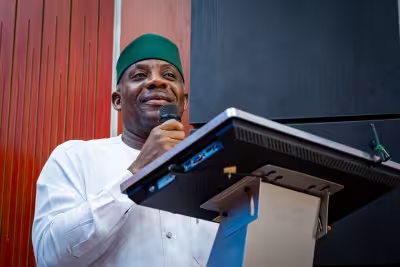





The Lagos State Electricity Regulatory Commission presented 14 electricity licences and permits during its maiden stakeholder engagement on May 7, approving independent distribution, metering services and interconnected mini-grid operations across the city.
Temitope George, speaking for LASERC at the event, said the approvals include a mix of project-specific and service licences that aim to tighten regulation and increase private sector participation. Among the approvals, Axxela Limited won a 5.8 megawatt project at Cadbury Nigeria Plc in Agidingbi, while Isolo Power Gen Limited received clearance for a 9MW installation along the Apapa-Oshodi Expressway in Isolo and Isolo Power Supply Limited secured an independent distribution network licence for the same location.
Daybreak Power Solutions Limited secured multiple approvals covering several large industrial and commercial sites — Seven-Up Bottling Company in Oregun, Crown Flour Mill in Ikorodu, Nigerdock FZE on Snake Island, Nigerian Breweries in Iganmu, Nigerian Bottling Company in Ikeja, and Promasidor Nigeria Limited in Isolo — a package that signals regulator backing for embedded generation tied to major load centres.
Other approvals included New Hampshire Capital Limited as a meter asset provider; GossLink Engineering Limited for operations up to 330KV and below and a separate licence for 400V vendor and importation; and Enaro Energy Mini-Grid Limited for an interconnected mini-grid project in Ishokan Phase 1 and Mercyland Phase 1 in Ayoyo-Ipaja.
LASERC framed the licences as part of a broader push to bring structure to Lagos’s electricity market. "This milestone underscores LASERC’s commitment to enforcing compliance, promoting investment confidence, and ensuring a structured electricity market that supports sustainable sector growth," the commission said.



Context for the approvals is simple and immediate: they cover independent distribution, metering services and interconnected mini-grids — the types of arrangements that allow companies to build generation and supply networks close to large consumers and communities, rather than rely solely on the state grid. LASERC said the move is intended to strengthen a regulated and transparent electricity market in Lagos and to reinforce its mandate on accountability and operational standards.
Tension remains between regulatory intent and delivery. George told attendees that LASERC is establishing zonal offices in Ikorodu, the Amuwo Odofin/Badagry axis and the Sangotedo/Epe axis, but those offices are not expected to become operational until the third quarter of 2026. That timetable leaves more than a year between licence awards and the on-the-ground expansion of LASERC’s local oversight — a gap that will test whether new approvals translate quickly into better enforcement and visible service improvements.
The approvals create a near-term pipeline of private projects, from megawatt-scale plants at industrial sites to community-scale mini-grids, and they hand the regulator new tools to demand standards. The practical questions now are operational: who will commission and connect these projects first, how meter asset provision will affect billing and accountability, and whether the zonal offices will be staffed and empowered to police the new licences by Q3 2026.
For companies listed among the beneficiaries and for Lagos electricity consumers, the real test is implementation. LASERC has used its maiden stakeholder meeting to set a regulatory framework; converting licences into reliable, measurable improvement in supply and metering will fall to project developers, network operators and the regulator’s yet-to-be-opened zonal offices.
Analysts and sector trackers, including nairametrics, will be watching the sequence: licence awards first, then project rollout, and finally the regulator’s local presence. If George and LASERC can close the gap between approvals and enforcement, the licences could mark the start of a more orderly and transparent electricity market in Lagos — if not, they will remain regulatory promises on paper until the third quarter of 2026 forces a reckoning.