



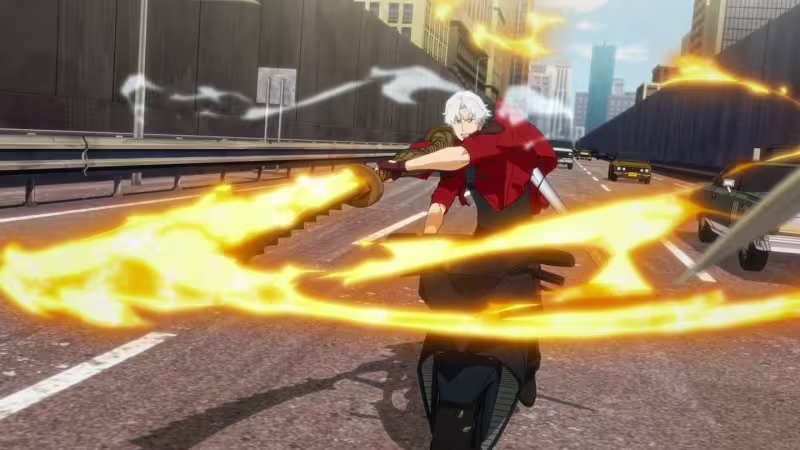
Netflix released Devil May Cry season 2 on Tuesday, May 12, 2026, delivering eight episodes that put showrunner Adi Shankar’s long game on display.
Shankar’s follow-through arrives with a voice cast that anchors the series in the familiar and the unexpected: Johnny Young Bosch returns as Dante and Robbie Daymond voices Vergil, while Scout Taylor-Compton plays Mary Ann Arkham — called Lady by Dante — and Hoon Lee appears as the villainous White Rabbit. The season carries a posthumous credit for Kevin Conroy; Conroy had not finished recording his dialogue as Vice President Baines before he died, and Ian James Corlett subsequently assumed the role. Season 2 picks up from the end of the first run — Netflix’s 2025, eight-episode season — whose finale revealed Vergil was alive and ended with Vice President Baines beginning the invasion of hell.
In February 2026, Shankar told Collider he planned a multi-season arc and elaborated on his intentions for this follow-up, saying, "I dislike when successful shows turn into comfort food. Devil May Cry won’t be TV that loops. My mission for Season 2 was to capture the feeling of a 2000s film franchise entry where the audience can’t predict the next turn." That line frames the season’s sharper turns: the writing pushes Dante back toward the fractured relationship with his estranged twin Vergil while asking new questions about who is really orchestrating the incursion that closed season one.
Devil May Cry is a Netflix original anime based on the Capcom video game franchise; the property extends across games, comics, literature and film. A previous television installment in 2007 lasted only a single season, making the current run and its ambitions a notable reversal of that earlier stop-start history. Season 2’s central storyline returns the show to its core conflict — Dante confronting Vergil — but it does so inside a production that now bears both a veteran voice cast and the operational wrinkles of a modern streaming franchise.
The frictions inside that production are the story behind the story. Conroy’s posthumous credit arrives with the practical reality that he had not finished recording Baines’ dialogue and that another actor completed the part. Separately, a recent report by MP1st said production for Devil May Cry season 3 is already in motion behind the scenes, even as Netflix has not officially announced whether the show will return for a third season. Those facts sit against Shankar’s public insistence on a multi-season plan, creating a gap between the showrunner’s stated intent and the studio’s formal silence.
The series also carries the smaller creative tensions that Shankar warned audiences to expect: episodes that trade predictable formulas for sudden tonal shifts and plot reversals more typical of a mid-2000s film franchise than a serialized comfort show. Viewers encountering devil may cry season 2 will find scenes that deliberately unsettle expectations — an approach that puts pressure on both the voice cast and the outlet that funds future episodes.
Given the MP1st report and Shankar’s plan for multiple seasons, the most consequential conclusion is straightforward: while Netflix has not officially greenlit a third season, production appears to be moving forward behind the scenes. That makes a third season the likeliest next step — not because the streamer has announced it, but because the creative team says it is building toward one and outside reports say work has already begun. For Shankar, whose aim was to keep the show from becoming “comfort food,” the release of Season 2 is less an ending than the first visible act of a longer, risk-taking project.