


Donald Trump warned Iran on Sunday that the "clock is ticking" as negotiations to end the war faltered, writing on his Truth Social feed: "They better get moving, FAST, or there won't be anything left of them" and "TIME IS OF THE ESSENCE!" The messages came the same day, the Times of Israel reported citing Benjamin Netanyahu's office, after Trump spoke with Israel's prime minister.
Trump's public ultimatum followed a week of blunt signals from Washington and blunt responses from Tehran: Iranian media said the United States had not offered concrete concessions to Iran's latest proposals, and the semi-official Mehr news agency warned that a lack of compromise from Washington would produce an "impasse in the negotiations." Both sides still appear to be far apart.
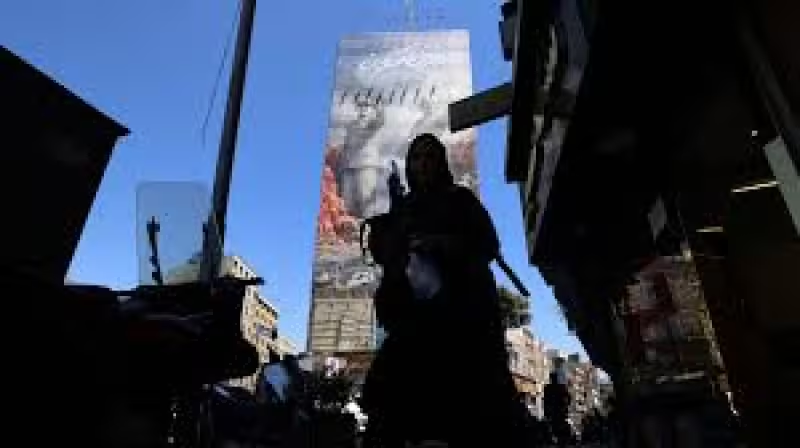
The numbers behind the urgency are stark. Israeli and US forces began massive air strikes on Iran on 28 February. Iran has continued to control the Strait of Hormuz, the chokepoint through which around 20% of the world's oil and liquefied natural gas travels, and Tehran says it is closing the waterway in retaliation for US and Israeli attacks. The move has sent oil prices soaring. Meanwhile the US has been enforcing a blockade of Iranian ports to pressure Tehran to accept its terms.
That pressure and the competing lists of demands and conditions now define the negotiations. Iran's semi-official Tasnim news agency said Tehran's package included an immediate end to the war on all fronts, a halt to the US naval blockade of Iranian ports, guarantees of no further attacks on Iran, compensation for war damage and Iranian sovereignty over the Strait of Hormuz. Iranian foreign ministry spokesperson Esmail Baghaei described those demands as "responsible" and "generous."

Washington, by contrast, has reportedly set five conditions in response, according to Iran's semi-official Fars news agency. Those reported US conditions include a demand that Iran keep only one nuclear site in operation and that it transfer its stockpile of highly enriched uranium to the United States. On Friday, Trump had suggested he would accept a 20-year suspension by Iran of its nuclear programme — a concession he floated even as he rejected Tehran's demands earlier this week, saying the truce was on "massive life support" and labeling the Iranian package "totally unacceptable."
The ceasefire meant to facilitate talks has largely been observed despite occasional exchanges of fire, but the military backdrop remains ugly. Pakistani officials are acting as mediators between Washington and Tehran; still, Iran controls the Strait and the US enforces a blockade, and those hard facts keep both the bargaining and the risk of renewed confrontation high.
The tension in the negotiations is not just over headlines and slogans; it is a concrete contradiction between positions that cannot easily be reconciled. Tehran has asked for a full stop to hostilities, guarantees and control over the Hormuz waterway, while Washington's response, as reported by Iranian outlets, asks Iran to dismantle much of its nuclear capability and to ship highly enriched uranium abroad. Trump’s recent offer of a 20-year suspension clashes with his refusal to accept Iran's demands and his public threats, leaving no obvious midpoint.
For readers tracking where this goes next, the immediate question is whether the truce can survive these gaps. The ceasefire has held largely so far, but with two major powers enforcing opposing pressures — US and Israeli air power having already struck, and Tehran holding the Strait — the combination of failed concessions and escalating rhetoric makes it unlikely that talks as currently framed will bridge the divide. If negotiators do not find a new path off the current collision course, the fragile pause that has kept the worst of the fighting in check will probably break, with direct consequences for global energy markets and regional stability.
For background reporting on how the ceasefire timetable and diplomatic moves have played out, see Donald Trump Warns as Two-Week Ceasefire Expires Wednesday,