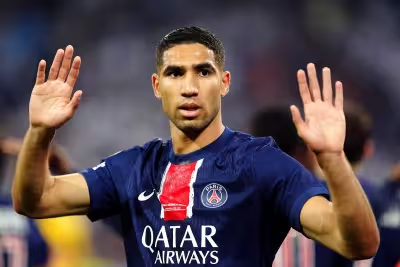
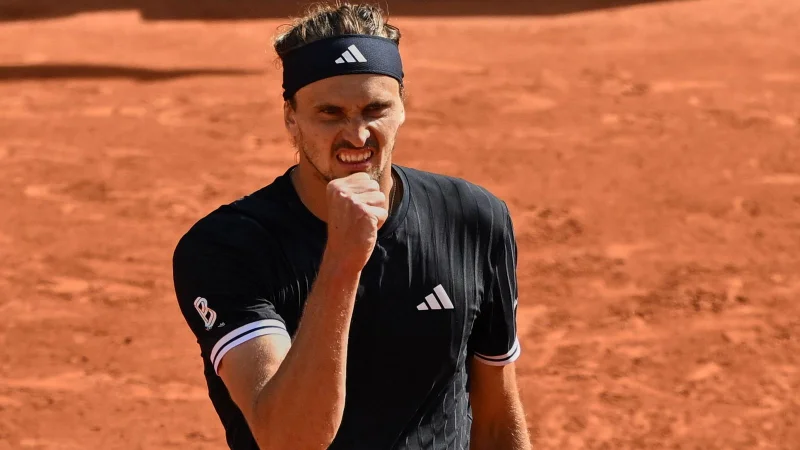
Alexander Zverev moved within sight of a Grand Slam Sunday at Roland-Garros, taking a 6-1, 4-6, 6-4 lead over Flavio Cobolli in the French Open men's final after a third-set break that handed him control of the match.
People are searching for zverev now because the second seed, a 29-year-old who has come to define near-miss majors, is one set and a break away from the biggest title of his career and the chance to become the first German man to win a Slam since Boris Becker at the 1996 Australian Open.
The scoreline is stark evidence of how the match has swung. Zverev dominated the opening set 6-1, Cobolli roared back to take the second 6-4, and their third set unfolded with the fine margins of a final: Zverev secured a decisive break to lead 6-4. Commentator Ryan Harrison captured the on-court seesaw in real time — "He's back in the driving seat of this French Open final" — after a sequence in which Cobolli missed a chance and Zverev pounced. Harrison turned on the empathy as well: "I'm not cheering for either player, I'm cheering for both of them to be their best and the moment is making it hard for them to do that."
The stakes could not be clearer. A victory would end a 30-year drought for German men in Grand Slam singles, while Cobolli stands opposite a different piece of history: an Italian man has not won the Roland-Garros singles crown since 1976. Broadcasters have modified coverage as the match reaches its climax — a sports channel has said it is carrying ATP and WTA action live, its written blog is currently unavailable, and live radio commentary is being offered to listeners in the UK only — all signals that the event has become a must-see moment in real time.
And yet the match carries a wrinkle that keeps the outcome uncertain: Zverev arrives in this position with a record of falling short in finals. Observers have pointed to that history as more than trivia. As another commentator put it, "Just when you think Alexander Zverev has got a bit of momentum behind him, he starts to falter." The three previous finals Zverev lost hang over this moment because the pattern invites pressure to reassert itself even when the scoreboard favours him.
That friction played out in tense rallies and micro-mistakes. Harrison narrated a string of moments that could have swung the match the other way — "What was that? A bad mis-hit from Flavio Cobolli and Alexander Zverev gets another shot to break back," he said — and then flagged how quickly momentum can evaporate: "The three break points disappear and Flavio Cobolli lets out a massive roar." Zverev, meanwhile, flashed both the shot-making that has taken him this far — "An amazing return from Alexander Zverev off a booming first serve, but then he misses a simple forehand" — and the small unforced errors that have characterised earlier final losses: "Alexander Zverev fires the first break point into the net..."
The human element remains central. Harrison, reflecting on the pressure players feel in a final, reminded viewers of his own career arc: "I empathise, it's not easy - I wasn't great in my first final either." That mixture of compassion and criticism underlines why the closing games here will feel heavier than normal for both players.
What happens next is simple and decisive: the match must be finished. Zverev now has the immediate chance to close out a first major and rewrite the narrative that has followed him to three previous finals, or to falter again and leave the question of whether he can win a Slam unanswered once more. Round Time News has earlier coverage of the build-up and semi-final action if readers want context before the final few games.