

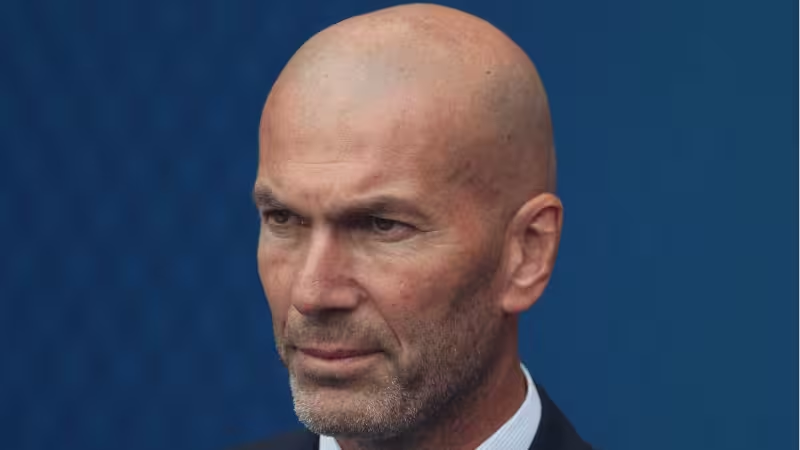
Zinedine Zidane told Real Madrid president Florentino Pérez at the end of 2022 that he did not want to return to the Bernabéu, even though discussions reportedly took place that could have led to a third spell in charge, according to Spanish media reports.
The offer, as described in reports, came after Xabi Alonso’s dismissal and amid a scramble inside the club. Pérez is said to have considered Zidane to replace Alonso; Football365 reported that the president contacted Zidane in December after Alonso was sacked. Zidane, now 53, has been linked to the club for two decades — he played at Real Madrid from 2001 to 2016 and coached the first team from 2016 to 2018 and again from 2019 to 2021, winning three consecutive Champions League titles during his managerial tenure.
Those achievements are the core of why Zidane’s name still carries weight at the club. The reports make clear that, despite the lure of a third return, Zidane told Pérez he did not want to take the job. Multiple outlets quoted people close to the conversations and suggested that a return was considered — but unwanted by Zidane.
The vacuum at the club is stark. Álvaro Arbeloa was promoted from Castilla in January as an emergency alternative to Alonso, and the team’s results have left Madrid searching for a successor. Reports have described serious internal tension, including player friction and dissatisfaction with Arbeloa’s work; Goal.com warned this weekend that the squad risks effectively abandoning the Clásico, and described the dressing room as a powder keg. Football365 conveyed a similar sense of collapse in morale, suggesting there was nobody at Real Madrid who could steady the situation.

That pressure explains why Pérez reportedly rang Zidane in the first place. But the story contains a sharp inconsistency about Zidane’s own timetable. Early accounts said he had promised the French Football Federation he would succeed Didier Deschamps after the 2022 World Cup. Yet Football365 later reported Zidane told Pérez he was already committed to taking over the France national team after the 2026 World Cup, and noted that Deschamps will leave his post after 2026. The two different timelines — a pledge tied to 2022 and a later commitment framed around 2026 — leave room for confusion about Zidane’s availability and intentions.
The contradiction deepens the dilemma for Real Madrid. Pérez reportedly explored Zidane as a stabilizing option even after Alonso’s exit, but the coach’s own reported refusals and shifting commitments to the France job mean the club cannot count on a familiar rescue. With Arbeloa holding the post temporarily and results poor, Madrid’s list of potential replacements has been broad: media have linked the club to José Mourinho, Didier Deschamps, Jürgen Klopp, Massimiliano Allegri, Mauricio Pochettino and Unai Emery in various combinations.
The clearest fact from the recent reporting is simple: Zidane was approached and he said no. Whether that no reflects a fixed decision to wait for France, a reluctance to re-enter a combustible dressing room, or both, is not settled publicly. For Real Madrid, the consequence is immediate — the club must move on without the man who twice restored its European dominance and won three straight Champions League crowns.
Given the repeated refusals and the competing timelines around a France appointment, the most plausible conclusion is that a third Zidane tenure at Real Madrid is unlikely. Pérez and the board will now be judged on who they appoint next and whether that choice can calm a dressing room described as a powder keg and steady a club in midseason turmoil.