




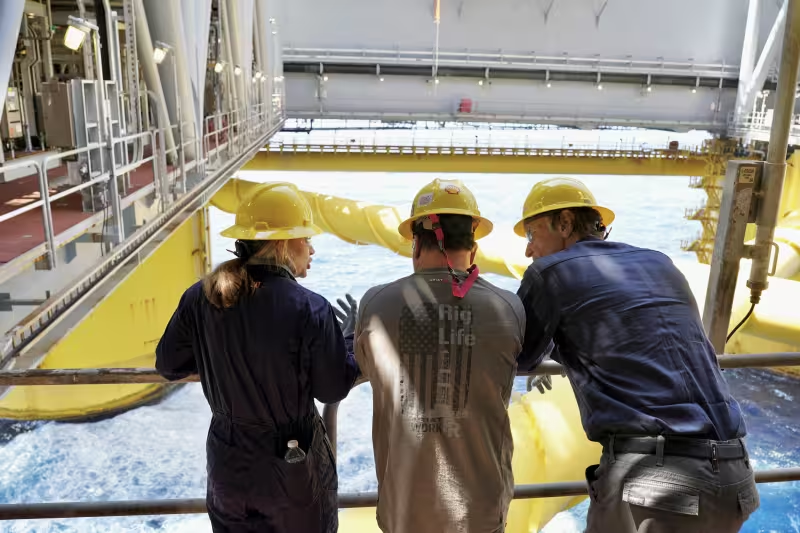
On Tuesday Ineos announced it had taken a 21 per cent stake in three oil and gas sites off the east coast of America and said its energy division would work with Shell to seek untapped reserves on the shelf.
The deal, which Ineos did not disclose a price for, commits the group to work with Shell Offshore Inc. on opportunities tied to the Appomattox platform in the Gulf of America and gives INEOS Energy a 21% working interest in the three sites.
The numbers underline why the move matters: Ineos has now committed over $3bn to its US operations, and the Fort Sumter discovery included in the agreement is estimated to contain more than 125 million barrels of oil equivalent on a site roughly 80 miles off the Louisiana coast.
David Bucknall, speaking for the company, framed the strategy plainly: "Partnering with Shell on these opportunities is a natural step" and the focus will be "areas close to existing infrastructure where we can move quickly, control costs and unlock new production." The supplementary report accompanying the announcement said the strategy includes Shell’s pre-FID Fort Sumter discovery, the planned Sisco exploration well and an additional exploration target expected by the end of the decade.
Context makes clear this is more than a single investment. Ineos is seeking to diversify away from upstream operations in Europe and the UK, and the Appomattox hub is expected to serve as a key anchor for future tieback developments in the region. INEOS Energy also said it will launch more exploration projects in the area before 2030.

The background driving that pivot is visible in plain figures: at the end of last year Ineos’s debt pile topped $18bn, and since September Moody’s has downgraded Ineos’s debt twice. In December the UK government injected £105m into Ineos’s Grangemouth plant after Ratcliffe warned the country’s last ethylene plant faced closure without state support.
Jim Ratcliffe has been explicit about why he is moving capital. He said "Europe is all over the place" and that "Growth in an economy is highly correlated to competitive energy prices, and it’s a huge issue for national security." He added, "If you can’t get energy, then you can’t run your hospitals, run industry or heat your houses." He told investors: "From an investment point of view, you always go to the stable rather than the unstable," and plainly concluded, "I would have a lot more confidence in investments in America in the energy sector than I would in Europe."
The announcement carries its own friction. Ratcliffe has publicly criticised British and EU policymakers even as his group has accepted UK support and managed a large debt burden — a contrast Brian Gilvary captured when he described parts of the policy debate as "almost ideological political vandalism of a natural resource." The company also declined to disclose how much it paid for the 21 per cent stake, leaving markets and competitors to guess at the valuation behind a move that now counts more than $3bn of US commitments on Ineos’s balance sheet.
Practically, the agreement with Shell narrows risk: the joint work will prioritise prospects within tieback distance of existing infrastructure, where the Appomattox platform can function as an anchor, rather than lone, costly greenfield developments. That narrower focus is central to Ineos’s pitch that it can move faster and control costs in the Gulf than in more regulated European waters.
This is a clear turning point. By committing material capital to American offshore projects and tying those projects to existing infrastructure, Ineos is accelerating a strategic shift away from European upstream exposure. The concrete next steps are mapped in the supplementary report: pursue Fort Sumter to final investment decisions, drill the planned Sisco well and pursue an additional exploration target before 2030 — moves that will show, in short order, whether the bet on America reduces Ineos’s financial strain and reshapes its global footprint.
For readers following the wider Ratcliffe story, this latest corporate pivot complements other public moves — from industrial rescues at Grangemouth to sporting investments — and helps explain why discussions about the group’s direction keep surfacing (see, for example, recent coverage of the manager search at Man U Live: