



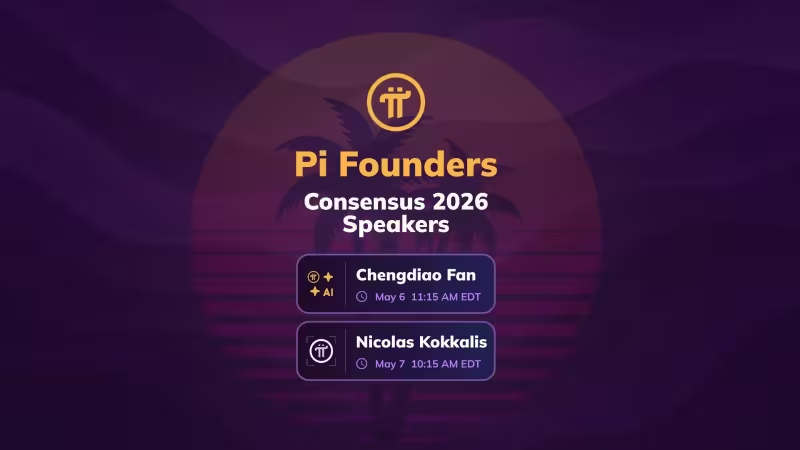
Dr. Chengdiao Fan will take the Convergence Stage on Wednesday, May 6, and Dr. Nicolas Kokkalis will appear on a panel Thursday, May 7, as Pi Network’s leadership lands in Miami ahead of a pivotal network upgrade.
Fan’s session carries the straightforward title, "Aligning Web3, AI and Blockchain for Utility," and Kokkalis will join a discussion called "How to Prove You’re Human in an AI World Without Doxing Yourself." Both appearances come days before Protocol 23, scheduled to activate on May 11, a release that the project says will add smart contracts and real-world asset tokenisation to its ledger.
The timing makes the speeches more than conference optics. Pi Network reports 16.5 million migrated users and more than 17.7 million KYC-verified accounts across more than 200 countries, supported by a node network of over 350,000 operators. The verification system behind that reach has processed more than 526 million verifications and relies on over one million human validators.
Those metrics track a busy rollout. The network shipped a subscription smart contract on testnet April 17, and Protocol 22 activated April 27. Further upgrades are scheduled through June, leaving Protocol 23’s May 11 activation as the next major checkpoint. Observers can read more about the project’s recent migration milestone at Pi Network News: 50 Million PI Moved in Second Migration Phase Before Consensus ( and about the Protocol 22 deadline at Coinpedia Blockchain & Fintech News Media: Pi Network’s Protocol 22 Hits Deadline, Smart Contracts Live (


Context from the team and accompanying reporting frames these Miami appearances as an effort to move the project past speculative buzz toward usable systems. The primary article on the roadmap says Pi Network's technical work is moving at its most active pace, that Fan is expected to talk about how crypto projects build lasting utility rather than short-term speculation, and that Kokkalis will address blockchain-based identity verification that distinguishes real users from synthetic ones without exposing personal data. The piece also notes Pi's verification infrastructure may be made available to other projects via API. For an outline of the founders’ planned themes at Consensus, see Pi Network Consensus 2026: Founders to Outline Identity and Utility Plans in Miami (
There is a clear friction point beneath the numbers. The network lists more than 17.7 million KYC-verified accounts but 16.5 million migrated users, a gap that highlights the transition still underway from verified accounts to fully migrated, on-chain identities. At the same time, Pi’s verification apparatus—over 526 million processed verifications and more than one million human validators—shows the scale and human cost of attempting to tie identity to a distributed ledger without a single central registry.
Another tension: the team pushed a subscription smart contract to testnet on April 17, and Protocol 22 only activated on April 27, leaving a compressed interval between test deployments and mainline upgrades. Protocol 23 promises to bring smart contracts and tokenised real-world assets to the live network; whether those features move cleanly from testnet demonstrations to the broader ecosystem will be the immediate technical and operational challenge.
For users and developers watching, the week in Miami is provisional theatre for a decision that lands on May 11. If Protocol 23 activates as scheduled and the smart-contract stack behaves under real-world load, Pi Network will have turned a roadmap into a functioning platform offering programmable subscriptions and paths to tokenise external assets. That would make the founders’ Miami message about aligning Web3, AI and blockchain for utility not just aspirational copy but an operational shift that affects millions of accounts and hundreds of thousands of nodes.
What happens next is straightforward: Protocol 23’s activation is the moment the network either validates the weeks of test deployments and KYC work or exposes the next set of engineering and governance stresses. Either outcome will be on display as Dr. Fan and Kokkalis return from the stage to the network they are trying to move from promise to production.