




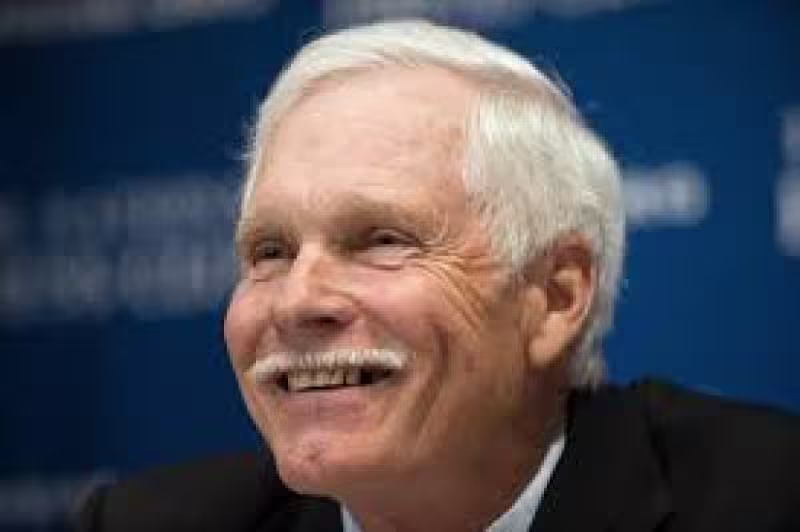
Ted Turner died at the age of 87, Turner Enterprises said Wednesday. "Turner’s vision changed journalism forever by making news immediate, global, and constant," the company said, a short statement summing up the element of his life that altered how the world watches events unfold.
Turner founded in 1980 and launched the first dedicated rolling news channel, a format described as the world's first 24-hour news network that would remake television. The network’s early speed and continuity — its nonstop updates during the assassination attempt on President Ronald Reagan in 1981, the Challenger disaster in 1986 and the live rolling coverage from Iraq during the 1990-1991 Gulf War — made its name literal and turned cable into a newsroom on constant alert.
Those changes were not small. Time named Turner Man of the Year in 1991 and observed that "He turned viewers into instant witnesses to history," a line that captures why Turner’s model mattered: it collapsed distance and delay, making television the primary way many people experienced big, unfolding events.
Turner’s influence reached beyond a single network. He built a media empire that included Cartoon Network and Turner Classic Movies, and he made a $1.5 billion acquisition of MGM film studios in 1985 before buying Castle Rock Entertainment and New Line Cinema in the 1990s. He owned professional teams — the Atlanta Braves, the Atlanta Hawks and the Atlanta Thrashers — and became one of the largest private landowners in the United States. He also turned his money toward diplomacy and development, founding the United Nations Foundation after pledging $1 billion to support UN initiatives.
His path to that scale began in family business and local radio. Turner took over the family billboard company after his father took his own life, bought a radio station in Atlanta, and within a decade that station had become the foundation of Turner Broadcasting System. He won the America’s Cup in 1977 and, for a decade beginning in 1991, was married to actress Jane Fonda.
Executives who worked with Turner pointed to a mix of instinct and relentlessness. Mark Thompson, a former leader at the network, called him a hands-on chief: "Ted was an intensely involved and committed leader, intrepid, fearless and always willing to back a hunch and trust his own judgement," Thompson said, adding, "He was and always will be the presiding spirit of. Ted is the giant on whose shoulders we stand, and we will all take a moment today to recognize him and his impact on our lives and the world." A former executive said Turner was "a once-in-a-generation media pioneer whose influence touched every corner of modern broadcasting," while a longtime associate summed him up simply: "Ted was fearless in his ideas and relentless in pursuing them," and "He believed in his instincts when few others did."
The public record of Turner’s later years includes a struggle he made visible. He revealed in 2018 that he was battling Lewy body dementia and, in a televised interview that aired on September 30, 2018, struggled to remember the name of the disorder. The contrast was stark: the man who built a machine to report the world's memory was himself contending with memory loss.
Turner leaves a mixed but unmistakable imprint. He remade television news into a nonstop, global enterprise and then used the profits and attention it brought to build entertainment brands, buy landmark film libraries and back large-scale philanthropy. As leaders at the network acknowledged, his approach changed the mechanics of journalism and the expectations of audiences.
For a medium that trades on immediacy, Turner's most durable legacy is structural: he embedded the idea that major events require live, continuous coverage, and he built the outlets that proved it could be done. That decision — to turn news into a round‑the‑clock product — is the clearest answer to why his death matters today: the routine of watching the world unfold on television began with him, and it will continue because of the institutions he created.