

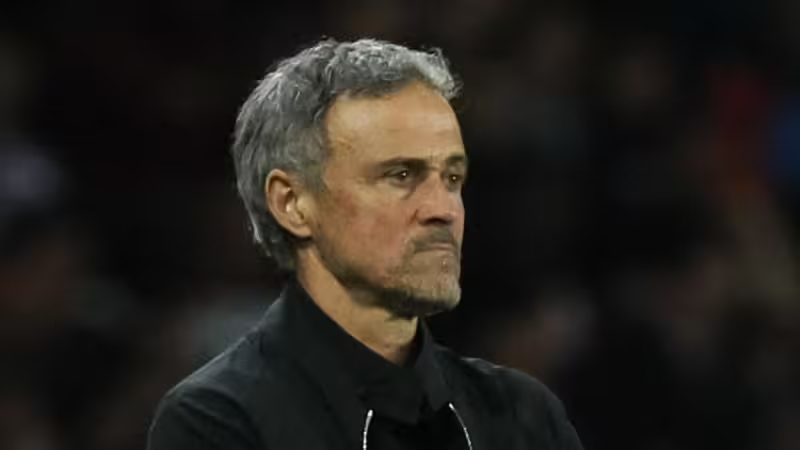
Luis Enrique watched his side edge Bayern 5-4 in a match that answered one question plainly: PSG can outscore elite opposition when it needs to. The scoreline was the headline; the numbers behind it are what will shape the debate in the days to come.
The most basic arithmetic is stark. PSG’s current squad, the one Luis Enrique is managing, has cost 815.15 million euros in transfers. Khvicha Kvaratskhelia, the club’s most expensive arrival, cost 80 million euros. By contrast, Bayern’s current squad has cost 423 million euros in transfers — roughly half of PSG’s investment — even though the Bavarian club fields expensive pieces of its own, like Harry Kane at a reported 95 million euros and Michael Olise at 60 million euros. Those figures make the 5-4 result feel less like an upset and more like a collision between two different construction philosophies.
Context matters: PSG’s outlay is now the visible fact of a wider change in approach at the club. The club has been shifting its transfer strategy, signing with more care and trying to identify or develop young talent at lower cost. Bayern, meanwhile, built much of its strength over time. Its investment has been spread across years with long-serving players embedded in the spine of the team. That model — steady accumulation, market scouting, taking advantage of free-agent windows and the structural dominance the club enjoys in its domestic league — helps explain how Bayern remained in contention in a game that finished 5-4 despite carrying a far smaller transfer bill.
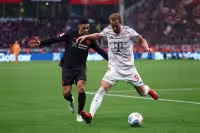

The match itself sharpened the tension between spending and cohesion. PSG’s heavy investment can be pointed to as proof that assembling a high-priced squad produces fireworks: nine goals, drama and a win. But the closeness of the scoreline undercuts any simple argument that money alone guarantees control. Bayern’s relative thrift, spread over a longer timeline, meant names and buy-in that kept the visitors competitive throughout. That gap between the size of PSG’s outlay and the narrowness of the margin exposes a question Luis Enrique now faces every week: does a star-studded, high-cost roster translate into consistent dominance, or does it require a different kind of management to convert spending into the steadiness that winning at the highest level demands?
The broader European landscape provides quick reference points. Real Madrid’s current squad had cost 705.8 million euros; Barcelona’s current squad stood at 404.3 million euros, with Frenkie de Jong among its costliest former signings at almost 90 million euros from Ajax. Those totals show there are multiple paths to competitiveness: heavy cumulative investment like Real Madrid’s, more restrained reconstruction like Barcelona’s, and the recent, concentrated spending that built the current PSG project to 815.15 million euros.
There is a practical wrinkle that the final score laid bare. Individual transfer fees — Khvicha Kvaratskhelia’s 80 million, Kane’s 95 million, Olise’s 60 million — matter in how teams are built and how expectations are formed, but they do not settle matches on their own. The very intensity of a 5-4 game suggests that coaching, organization and the blend of experienced and new signings are equally decisive. Bayern’s model of spreading investment across time, keeping long-serving players at its core, and exploiting scouting and market circumstances continues to yield a team that can contest even when outspent on paper.
For Luis Enrique, the evening offered both vindication and a mandate. His team scored five and won; it also conceded four. The victory makes the case that PSG’s spending can generate the elite-level attacking output the club sought when assembling an expensive squad, but it also insists on a follow-up: turning such volatile spectacle into consistent, defensible performances. That tension — between headline-grabbing transfers and the day-to-day work of forging a reliable team — is now his immediate problem to solve.