


During a plenary presided over by Deputy Senate President Jibrin Barau, Senator Opeyemi Bamidele moved and the Senate rescinded a clause that had required senators-elect to elect presiding officers only after taking their oaths of office.
The reversed provision had been introduced under amended orders 2 and 3 and made oath-taking a mandatory condition before senators-elect could participate in the election of the President and Deputy President of the Senate; the Senate said the provision could create "constitutional inconsistencies and unintended tensions" with section 52 of the 1999 constitution.
The change returned the chamber to its previous parliamentary procedure, where newly elected senators in the 11th Senate may vote for presiding officers before being sworn in. Under the now-rescinded order 2, the clerk to the National Assembly had been required to administer the oath of allegiance and oath of membership after roll call and confirmation of writs of election; order 3 had stipulated that a senator-elect "shall not participate in any proceedings of the Senate, including voting for the election of the President and Deputy President of the Senate, unless and until he had taken the oaths." The Senate said the reversal was necessary to keep its rules consistent with constitutional provisions, parliamentary conventions, and legislative practice.
The rescission was carried at plenary and formally adopted under the motion for rescission and recommittal sponsored by Bamidele. Speaking on the floor, Bamidele warned colleagues: "We are not going to allow this to continue," and invoked the chamber's own rules, quoting "Order 52 of the senate. It simply says, Mr. President, that it shall be out of order to attempt to reconsider any specific question upon which the Senate has come to the conclusion during the current session, except upon a substantive motion for decision." He added: "So, if His Excellency Distinguished Senator Adams Aliyu Oshiomhole, CON, had any problem with the decisions that were taken with respect to the amendment two days ago, what he was expected to do was to bring the substantive motion for the session to be debated on the floor of this parliament." Bamidele accused Adams Oshiomhole of causing unnecessary "drama" on the floor of the Senate.
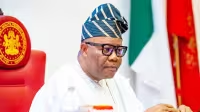
Adams Oshiomhole reacted in plenary, saying: "This shows that when there are amendments, the next time, we should allow debate. That’s it," reflecting the dispute that had already spilled into open confrontation on Wednesday between Oshiomhole and Godswill Akpabio over the amendments.
The row followed amendments adopted two days earlier that altered long-standing parliamentary procedure to require that the election of a Senate President be held only after senators-elect had taken their oaths. Those amendments touched on how the chamber would conduct its first sitting after an election and who may participate in its opening business.
Supporters of the rescission argued the amended orders risked colliding with section 52 of the 1999 constitution and established legislative practice, and that the Senate must keep its standing orders aligned with constitutional and parliamentary norms. Opponents had said the oath requirement would formalize a sequence for constituting leadership that could change how the 11th Senate organised its first day of business.
The immediate practical effect of the vote is clear: senators-elect can again participate in the election of the President and Deputy President of the Senate before taking their oaths, reverting to the procedure that had governed previous inaugurations. Procedurally, Bamidele’s invocation of Order 52 places the burden on any senator who objects to a standing-order change to bring a substantive motion for debate rather than pressing the point during ad hoc exchanges on the floor.
By rescinding the contested clauses, the Senate restored the established sequence for opening its 11th Senate and left explicit the pathway for any future challenge: a substantive motion brought and debated under the chamber’s standing rules.