



Seventeen members of the House of Representatives formally left the African Democratic Congress for the Nigerian Democratic Congress on Tuesday, their defections read into the record by Benjamin Kalu during plenary.
Kalu stood at the lectern and presented the notices that transferred the lawmakers’ allegiances; their moves were announced on the floor of the House during Tuesday’s session and add a sizeable bloc to the NDC’s parliamentary ranks at a moment of intense pre‑election realignment.
The defections came two days after Peter Obi and Musa Kwankwaso formally joined the Nigerian Democratic Congress from the African Democratic Congress on Sunday, and one of the defectors on Tuesday, Leke Abejide, announced a different exit—he left the ADC for the All Progressives Congress the same day.
The lawmakers themselves said leadership and legal crises inside the ADC drove their departures. Several cited internal battles and constant court cases that, they said, sapped the party’s unity and usefulness as a vehicle in the run‑up to the 2027 general elections.
Peter Obi, who had joined the ADC from the Labour Party in December 2025 and now moved again, framed his decision as structural rather than personal. "Let me state clearly: my decision to leave the ADC is not because our highly respected Chairman, Senator David Mark, treated me badly, nor because my leader and elder brother, Alhaji Atiku Abubakar, or any other respected leaders did anything personally wrong to me. I will continue to respect them," Obi said, and added: "However, the same Nigerian state and its agents that created unnecessary crises and hostility within the Labour Party that forced me to leave now appear to be finding their way into the ADC, with endless court cases, internal battles, suspicion, and division, instead of focusing on deeper national problems and playing politics built more on control and exclusion than on service and nation‑building,"

The exodus is large both in number and timing: 17 lawmakers shifting party benches in a single day is a material gain for the NDC and a setback for the ADC as the parties jockey for advantage ahead of 2027. The House has recorded a wave of defections since the beginning of the year, and this batch punctuates a broader scramble for alignment and influence.
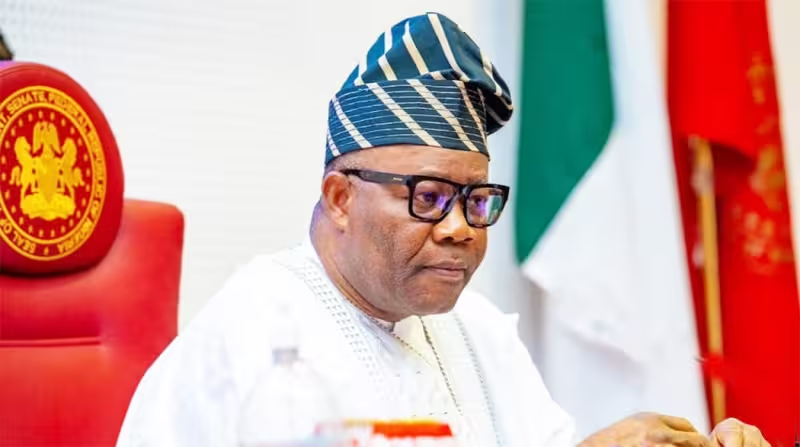
Not everyone treated the ADC’s trouble as nuanced. Punch reported Senate President Godswill Akpabio as saying bluntly that the party was "effectively dead" after the defections: "Resignation from ADC and declaration for Labour Party. Maybe all those defecting from ADC should just compile everything in one paper and bring, so that we don’t keep announcing, announcing, announcing. Because I think ADC is dead," he told reporters, according to the report. Akpabio added a jab about the frequency of switches: "How many times can you defect in a month? Once. But some have done three times," and urged would‑be movers to file joint notices so defections stop looking like a ritual: "So that it doesn’t look like a daily ritual. If you are defecting from Labour, you write all of you. If you are moving from ADC, you write all of you. If you are entering NDC, you write all of you,"
Punch also reported that Victor Umeh joined the NDC, citing internal crises and unending litigation within the ADC as his reasons, reinforcing the narrative that litigation and leadership fractures are central to the party’s current collapse.
The immediate consequence is simple: parliamentary arithmetic and public perception have shifted. By adding 17 votes at once, the NDC strengthens its negotiating position inside the House and gains momentum in public messaging. For the ADC, the loss deepens questions about whether it can present a coherent platform or campaign apparatus as the 2027 general elections approach.
The tension now is between the practical effect of numbers and the durability of new loyalties. Defections change labels but not always long‑term behavior; party cohesion and voter networks will determine whether the NDC’s gain holds and whether the ADC can stop the bleeding.
Ultimately, the most consequential question is whether a party whose troubles are described as legal fights and leadership schisms can rebuild credibility and organization before the 2027 contest; if it cannot, the coming year will likely see more of the same—and the balance of power in the House will be reshaped not by policy but by paperwork read at a plenary.