



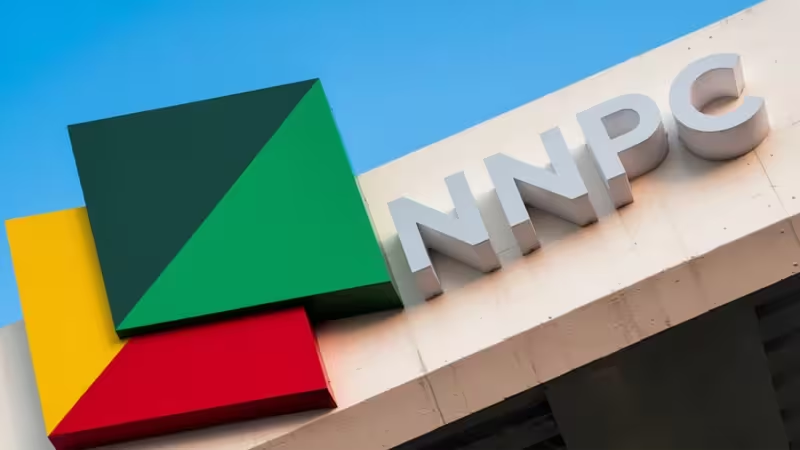
On April 30, 2026, Nigeria’s state oil company NNPC signed a memorandum of understanding in Jiaxing City, China, with Sanjiang Chemical Company Limited and Xingcheng (Fuzhou) Industrial Park Operation and Management Co., Ltd. to pursue rehabilitation and operation of the Warri and Port Harcourt refineries. A statement announcing the agreement was released three days later.
The document signed in China is billed as a technical equity partnership intended to complete rehabilitation work and restart operations at both refineries. NNPC described the MoU as a preliminary framework; the supplementary material accompanying the announcement made clear it does not amount to an immediate contract award or a direct expenditure commitment by NNPC Ltd.
The practical weight of the MoU rests on a recent record that has left the Warri plant largely inactive. The Warri refinery was declared operational in December 2024 but was shut down one month later and then taken offline for maintenance on May 24, 2025. That maintenance was initially expected to last thirty days; instead the refinery has remained broken or shuttered and, by February 2026, NNPC’s chief executive officer had disclosed that the refineries were operating at significant losses. Rehabilitation of the plant has already cost Nigeria close to $900 million.
The deal is being discussed under many headlines and search labels, including the phrase atiku abubakar nnpc refinery deal, but the concrete action recorded in Jiaxing was the MoU and its technical-equity framework rather than a binding construction or purchase contract. The agreement’s backers say Chinese firms have experience delivering large industrial projects; Collins Eshiofeh said the pact "could end Nigeria’s long-standing dependence on imported petroleum products," called it "a strategic intervention capable of reshaping Nigeria’s energy sector," and added that "China had earned a global reputation for delivering major industrial and infrastructure projects."

There is a clear tension between that promise and the market forces reshaping Nigeria’s oil industry. Indigenous firms now account for over 60 percent of Nigeria’s current crude oil and gas output. In the first half of 2025 Seplat Energy and Aradel recorded strong production growth; Seplat has absorbed ExxonMobil’s upstream assets and reported total assets of ₦9.36 trillion for that period, while Aradel’s balance sheet stood at ₦1.81 trillion. Those companies are already operating across the upstream, midstream and downstream value chain simultaneously, suggesting domestic capacity to run major assets exists even as state refineries struggle.
That contradiction—foreign technical partners on a paper deal while homegrown firms expand output—underscores what the MoU does not resolve. The primary article tracing the Warri refinery’s history notes repeated turnaround maintenance cycles and major spending that left the plant repeatedly broken or shuttered. The supplementary article frames the China agreement as aiming to drive rehabilitation, restart and expansion, but it stresses the preliminary nature of the memorandum.
What happens next is decisive: the MoU must be translated into enforceable contracts, clear financing and operational guarantees if the refineries are to move from a cycle of repair to reliable production. Given the $900 million already spent on rehabilitation and the shutdown that followed the December 2024 restart, the odds of success will hinge on who takes equity, who underwrites future work and whether operators can deliver sustained output rather than short-lived restarts.
For now, the signing in Jiaxing is a necessary step, not a finish line. If the technical equity model turns into binding commitments, it could change Nigeria’s fuels market; if it remains a preliminary framework, the country will still face the familiar risk that big promises do not end chronic outages. Collins Eshiofeh’s assessment captures both the hope and the wager: the agreement "could end Nigeria’s long-standing dependence on imported petroleum products" only if the framework yields real, lasting operations.