



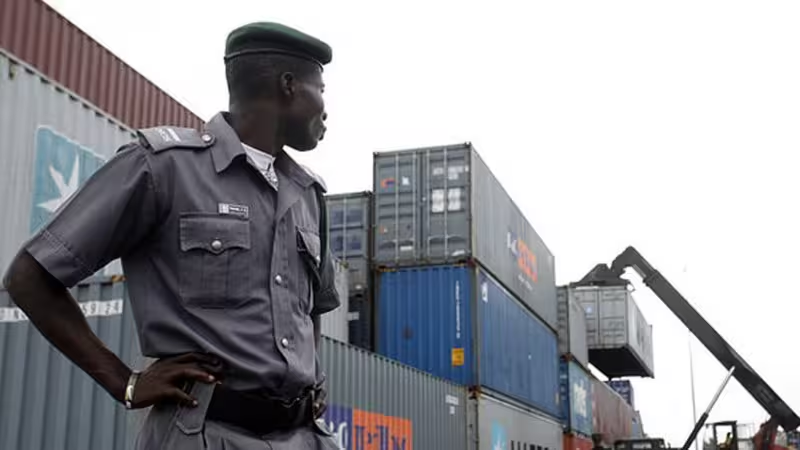
The Nigeria Customs Service said it intercepted and recovered seven luxury vehicles at Tin Can Island Port in Lagos, a seizure it linked to stolen cars traced by Canadian authorities.
An internal Customs document dated May 5, 2026, lists the recovered vehicles as a 2019 Lexus RX350, a 2019 Mercedes‑Benz G550, a 2023 Land Rover Range Rover, a 2019 Lamborghini Huracán, a 2021 Rolls‑Royce Dawn Convertible, a 2018 Lamborghini Aventador and a 2026 Toyota Tundra.
Customs officials said the cars had been stolen in Canada before being illegally exported and shipped into Nigeria, and that the recovery followed intelligence sharing and joint collaboration between the Nigeria Customs Service and the Royal Canadian Mounted Police.
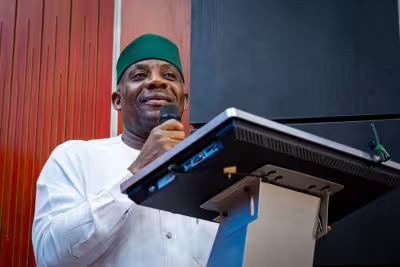
What started as routine cargo checks at the port quickly became an international enforcement action, Customs spokesman Frank Onyeka told journalists on Sunday. "What looked like a routine cargo movement quickly became an international criminal investigation. Once intelligence reached us, we placed the consignment under enforcement watch and secured the vehicle pending confirmation from Canadian authorities," he said.
The seizure documents and Customs statements say seven luxury vehicles were involved and that Canadian authorities had traced several stolen high‑end cars believed to have been smuggled into Nigeria through international shipping channels. One of the intercepted vehicles was identified separately as a Toyota Tacoma hidden inside a container that was transporting other vehicles.

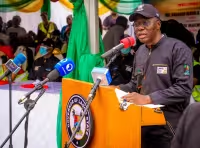
Customs delayed the release of the recovered cars until officials of the Canadian government arrived to complete the identification and recovery process. The handover was made to the Deputy High Commissioner of Canada to Nigeria after the Canadian team had verified the identities of the stolen vehicles, the Customs Service said.
The Nigeria Customs Service framed the interception as part of broader efforts to strengthen international collaboration against smuggling and transnational vehicle theft. Its officials credited coordinated intelligence exchange, cargo profiling and maritime enforcement with making the recovery possible.
Tension in the case comes from how the shipment left Canada and entered the international supply chain. Canadian authorities had traced the thefts and the export route, but the fact that a Toyota Tacoma was concealed inside a container carrying other cars points to sophisticated concealment methods that can defeat routine inspections. Customs also said there were attempts by unnamed parties to intervene in the handover process; Onyeka said bluntly, "We had people who wanted to step in on behalf of others, but this was too sensitive. We insisted the handover must be directly to the Canadian government to preserve the integrity of the process."
The recovery underscores how maritime shipping routes can be used to move high‑value stolen goods across continents and how law enforcement cooperation can interrupt those flows. Canadian tracing of stolen vehicles and the Nigeria Customs Service’s enforcement watch combined to keep the consignment at port until identities could be confirmed and custody transferred.
For Onyeka and the Customs Service, the operation is evidence that tighter cargo profiling and intelligence partnerships can work. The immediate result was the return of seven cars — including a rolls-royce Dawn — to Canadian custody; the longer consequence, Customs says, should be a harder environment for cross‑border vehicle theft networks that exploit shipping lanes.