



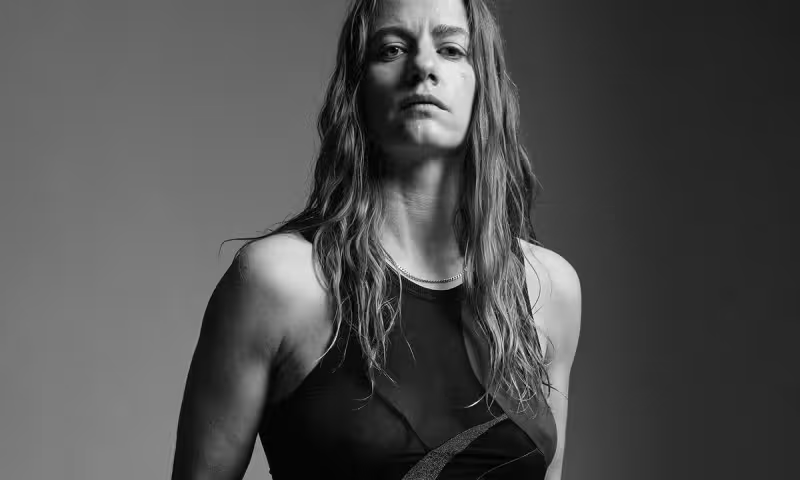
Florentina Holzinger has built Seaworld Venice for Austria’s pavilion at this year’s Venice Biennale, an installation described as a dizzying, immersive, confrontational and shocking rumination on climate change, technology and a flooded, dystopian future.
Holzinger’s piece arrives to the Biennale under the curatorship of Nora‑Swantje Almes, who said the pavilion has drawn support from national selectors and the ministry. "The reaction we got from the ministry was a very positive one. Very encouraging, very supportive," Almes said.
The work’s language — flooding, drifting fragments of machine and body, and technological detritus reimagined as landscape — has prompted immediate comparisons to science‑fiction visions of a drowned world. The 1995 film Waterworld is the obvious referent: that film set its action on floating junk islands after polar ice caps melted. But Almes pushed back on any direct lineage. "I’m not aware of any direct references to sci‑fi in the show," she said, and when asked specifically about Waterworld she answered plainly, "I have not seen it, no." She even posed a wry suggestion: "Should we have a watch party this evening?"
Those denials sit beside a history that makes Holzinger’s newest work feel like the next escalation in a steady pattern. Her 2019 body horror ballet Tanz premiered in Vienna with explicit content warnings for nudity, blood, needles, strobes and graphic violence. In 2022, Ophelia’s Got Talent included a real helicopter and nude performers. And this year, 18 people were treated for severe nausea after performances of her opera Sancta in Stuttgart. The catalogue of extremes helps explain why Seaworld Venice is being called confrontational and shocking rather than merely topical.
Almes framed the pavilion’s choice as conscious and defensible. She noted Holzinger’s international standing — "Florentina’s work is also internationally recognised" — and placed her practice within a living Austrian aesthetic. "Certainly, in the collective consciousness of Austria, having blood and other body fluids on stages, et cetera, is not necessarily shocking," Almes said, invoking a lineage that traces back to the Viennese Actionists.
That lineage matters. Austrian selectors were "happy to platform" Holzinger’s work, an institutional decision that signals the pavilion sees Seaworld Venice as part of a national conversation about art’s limits and responsibilities. The piece’s explicit focus on climate change and technology gives that conversation a topical urgency: this is art staking a claim on how we imagine a watery future, and doing so with the tactics of provocation.
The tension is plain. On one side is the spectacle—the dizzying immersion and machinery that make the installation feel like a direct cinematic afterimage. On the other is the curator’s insistence that any resemblance to sci‑fi is coincidental and that the work belongs in a line of Austrian performance that uses real bodies, fluids and heavy apparatus to test viewers’ limits. Those two claims can be true at once: a work can unsettle like a blockbuster and still be rooted in a tradition of transgressive live art.
For viewers wondering whether Seaworld Venice is an homage to film or an extension of a specific performance lineage, the evidence points clearly to the latter. Holzinger’s recent productions — Tanz, Ophelia’s Got Talent and Sancta — form a throughline of bodily spectacle and mechanical risk. The pavilion’s selectors and Austria’s ministry signed off on that trajectory, and the curator says the work is internationally recognised, not a pop‑culture riff.
Seaworld Venice, then, should be read as the latest chapter in Holzinger’s practice: an intentionally provocative, technicolor staging of ecological collapse that leans on the aesthetics of shock to force attention. If the installation echoes cinematic images of oil‑slick oceans and floating junk, that echo is incidental; the aim, as the curator frames it and as Holzinger’s record demonstrates, is to extend a confrontational national tradition into a conversation about climate and technology at the Biennale.