



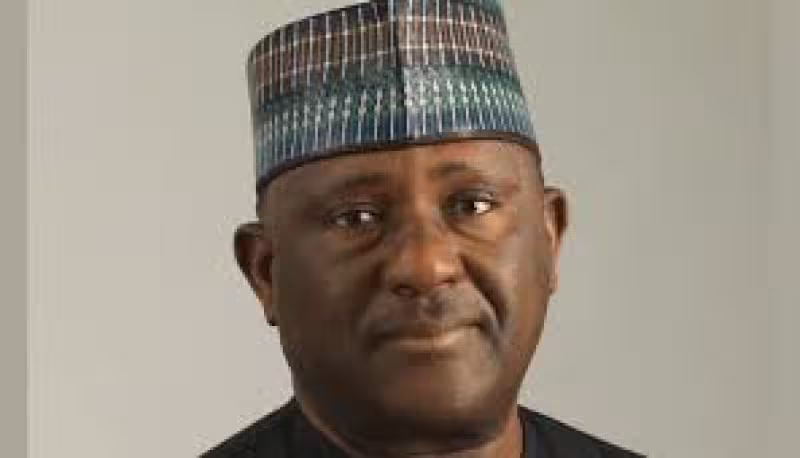
Abdul Samad Rabiu has become Africa’s second-richest individual after his net worth rose to $18.6 billion on the Billionaires Index, the ranking showed.
The rise vaulted Rabiu past South African luxury heir Johann Rupert, whose wealth declined to $17.9 billion, leaving Rabiu ranked 138th globally while Rupert sat at 153rd. Rabiu’s year-to-date gain on the index was about $8.47 billion — the largest increase among African billionaires so far in 2026.
The scale of the movement is striking: Rabiu had been estimated at about $15.9 billion earlier in 2026, and a March report from Forbes had said his net worth surged by $6.1 billion over the prior year to roughly $11.2 billion, a near 120 percent jump that moved him from sixth to third on the continent in that publication’s tally.
’s update through May 7 showed those gains continuing, driven largely by stronger valuations across Rabiu’s industrial holdings. The sourcing behind the index links the rise to his cement, food processing, sugar refining and manufacturing businesses, notably assets under the BUA Foods and BUA Cement banners.
Despite Rabiu’s leap, the continent’s wealth hierarchy remains topped by Dangote, who retained the richest position in Africa with a net worth of $34.4 billion and a global ranking of 66th on the list. The May 7 ranking also did not include any other Nigerian billionaires among the world’s top 500: Mike Adenuga, with an estimated $6.5 billion, and Femi Otedola, at about $1.3 billion, were not listed in the global top 500 on that date.

The arithmetic behind the reshuffle is simple and severe: Rabiu’s $8.47 billion year-to-date increase versus Rupert’s roughly $1.76 billion decline this year created the gap that produced the change in continental order. Rabiu’s new standing on the Billionaires Index — which updates daily — reflects recent market moves and revaluations of private and public holdings that feed into the daily tally.
The contrast with earlier published estimates underscores the volatility of wealth rankings tied to commodity-linked and industrial assets. In March, Forbes’ assessment of Rabiu put him at $11.2 billion after a reported $6.1 billion surge over the previous year; by May, ’s daily index showed a further climb to $18.6 billion, a pace that made him Africa’s strongest-performing billionaire in 2026 on that metric.
There is a tension between the headline numbers and the business realities they represent. The indexes measure fortunes through shifting market valuations and available disclosures, not through a fixed ledger, and that can produce wide swings in short spans. Rabiu’s gains are concentrated in a handful of industrial businesses — cement and food among them — meaning his ranking depends heavily on continued strength in those sectors and on how investors value those companies going forward.
The practical next step for observers is straightforward: daily index updates will determine whether Rabiu’s ascent holds. If valuations across his cement, food and manufacturing interests remain firm, his place near the top of Africa’s wealth table is likely to persist; if those sectors reverse or if other owners’ assets reprice, the continental order could shift again as quickly as it changed this spring.
For now, the fact is clear and narrow: Abdul Samad Rabiu’s industrial holdings have propelled him from an earlier 2026 estimate of about $15.9 billion into second place on the continent at $18.6 billion, overtaking Johann Rupert and leaving Dangote alone at the top — a snapshot that reflects both rapid gains and the fragile arithmetic of billionaire rankings.