





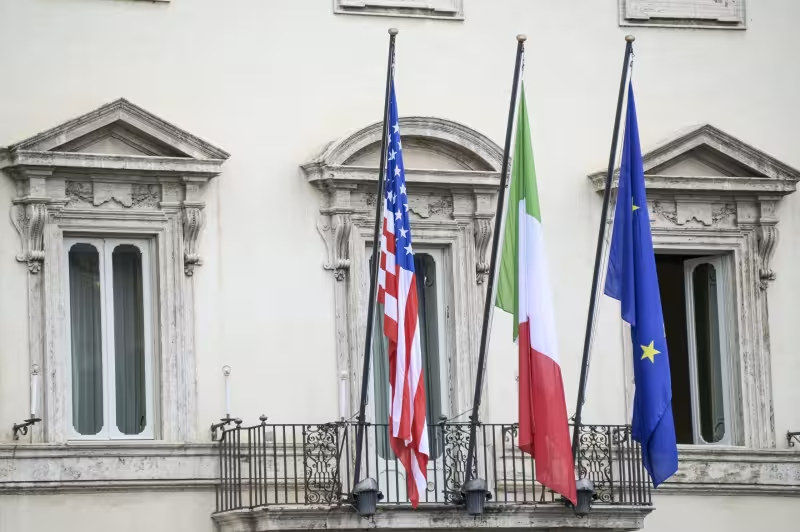
The United States and Italy held their second bilateral space exploration Dialogue in Washington on April 9–10, 2026, building on a political commitment Giorgia Meloni and Donald Trump made in April 2025 to expand cooperation. The talks moved the partnership further into security, commercial space and resilience, not just scientific exchange.
Washington Dialogue
Officials from both sides framed space cooperation as central to national and collective security, and they highlighted work between Italian public institutions and U.S. private operators in low-Earth orbit, secure connectivity and space-based services. The dialogue also focused on cyber vulnerabilities and space debris as threats to space systems.
That mix shows how the relationship is being handled now: as a strategic domain with industrial, security and governance dimensions. It also pushes the conversation beyond the transatlantic axis, because the dialogue included training, education and capacity-building for emerging space actors in Africa and Latin America.



NASA and Adolfo Urso
The two countries said they would enhance cooperation on space cybersecurity and resilience. They also reaffirmed cooperation with NASA, including a recent statement of intent signed with Italy’s Minister Adolfo Urso.
For Italy, that keeps a formal line open to U.S. civil space work while widening the agenda into areas that affect operators handling data, connectivity and orbital services. For U.S. private operators, the Washington talks point to a framework in which Italian public institutions are expected to play a larger role.
Italy and the United Nations
The United States welcomed Italy’s upcoming chairmanship of the United Nations Committee on the Peaceful Uses of Outer Space. That gives Rome a visible role in space governance at the same time Washington and Rome are tying their own cooperation to security and resilience.
Meloni and Trump set the political direction in April 2025, and the Washington dialogue turned that commitment into a broader agenda with specific operational lanes. The next test is whether the bilateral work on cybersecurity, private-sector access and international coordination translates into concrete projects across the agencies and operators already named in the talks.