



President Donald Trump said today that Iran has reached out and asked Washington to lift its naval blockade on Iranian ports, comments he paired with blistering warnings on social media. Trump posted, "Iran can’t get their act together. They don’t know how to sign a nonnuclear deal. They better get smart soon! President DJT" and also wrote, "they better get smart soon" and "No more Mr Nice Guy."
The statements landed as Pete Hegseth is due to face questioning from lawmakers before the House Armed Services Committee for the first time since the Trump administration went to war with Iran. The scheduled hearing is being held to discuss the administration's 2027 military budget proposal, which would boost defence spending to $1.5 trillion and frames the fiscal backdrop for any diplomatic overture from Tehran.
Those figures matter in sharp practical terms: a $1.5 trillion defence plan would set the resources the administration says it needs while it conducts and sustains hostilities. Lawmakers will question Hegseth today about how that money would be used and what risks remain as the White House describes a mix of pressure and negotiation with Iran.
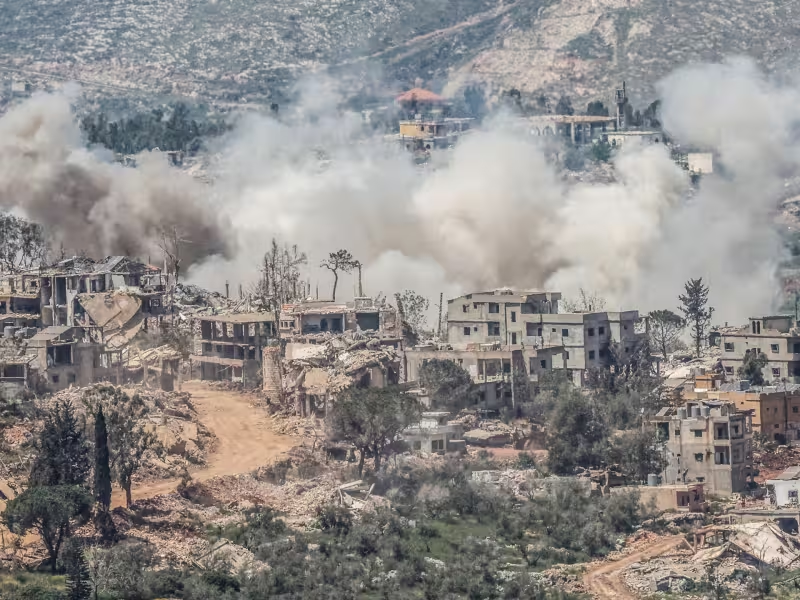
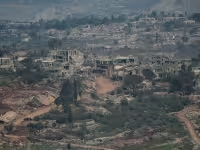
The president’s claim of Iranian outreach sits inside a wider and worsening regional picture. More than 1.2 million people in Lebanon are expected to face acute hunger because of the war between Israel and Hezbollah, a joint statement from the UN's Food and Agriculture Organization, the World Food Programme and Lebanon's Agriculture Ministry said, estimating 1.24 million people will face food insecurity at crisis levels or worse between April and August 2026. The statement noted this was a significant deterioration from March, when an estimated 874,000 people were experiencing acute food insecurity.

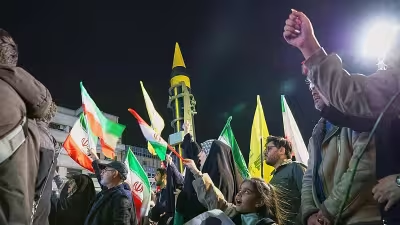
Humanitarian strain is only one thread. Israeli forces issued demolition orders for Palestinian homes in the Silwan neighbourhood of occupied East Jerusalem, adding another flashpoint that sits alongside the larger conflict involving United States,">the United States, Israel and Iran. Economic ripples show up too: in late February, the United States and Israel began attacking Iran, and Firouz moved all his crypto savings out of Nobitex 12 hours beforehand. Firouz told reporters, "I was feeling all week the war would start soon" and said, "My main thinking was that I could potentially be forfeiting true ownership of any money left in a state-linked or state-monitored Iranian crypto service in the event of war, whether through an action taken by state authorities or as a consequence of cyberattacks." Iran's crypto ecosystem was valued at more than $7.78bn last year.
The tension is plain: an administration publicly claiming Iranian appeals for relief from a naval blockade while the president is simultaneously issuing public threats, and while Congress debates a defence budget that would lock in $1.5 trillion of military spending. That creates a credibility gap between an ostensible opening from Tehran and the posture Washington is formalizing through its budget priorities and public rhetoric.
Lawmakers will press Hegseth today on how the budget and the administration's policies line up — whether funds will support de-escalation, sustain offensive operations, or both — and whether the executive branch treats an Iranian request to lift a blockade as an opportunity for diplomacy or a bargaining chip. The hearing occurs as other parts of the conflict continue to generate humanitarian and legal fallout, from Lebanon's hunger crisis to demolition orders in East Jerusalem.
The most consequential conclusion the facts support is blunt: Washington is preparing to underwrite a prolonged military posture even as it says Tehran has sought relief from a blockade. That combination — a public claim of outreach from Iran, a president’s hardline social media warnings, and a $1.5 trillion defence package moving through the machinery of government — suggests the administration is readying to keep military options on the table while testing whether Tehran will respond to pressure. Coverage of the diplomatic and economic fallout has touched unexpected corners of global life, ranging from reporting on trade partnerships to sports diplomacy — see early reporting like Embassy Of The United States, Abuja Reaffirms Five-Year Trade Partnership and Infantino Says Iran Will Travel to United States for World Cup 2026 — underscoring how the conflict is reshaping both aid needs and international ties.