




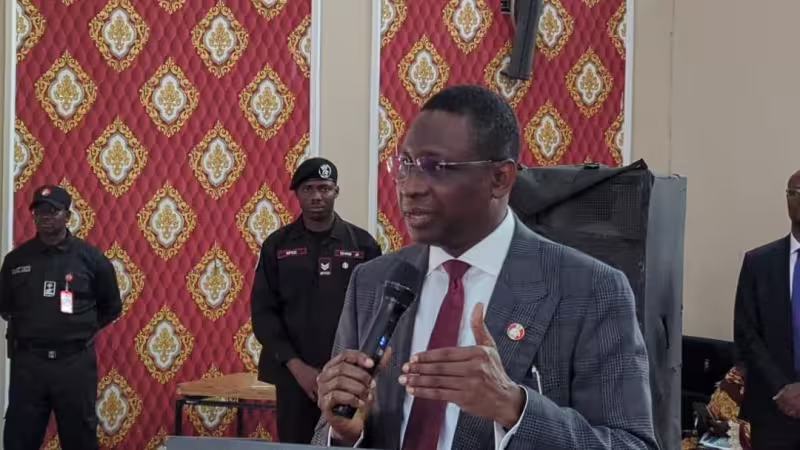
The Economic and Financial Crimes Commission says Nigerian universities are losing ground to fraud, cybercrime and weak financial controls, with its chairman warning that students are now part of the problem at alarming scale. Ola Olukoyede said on Tuesday in Kano that the agency has already investigated cases of inflated contracts, ghost workers and diverted student fees across tertiary institutions.
Olukoyede, the Executive Chairman of the commission, spoke at the 8th Biennial Conference of the Committee of Pro-Chancellors of State-Owned Universities in Nigeria, where the theme centered on artificial intelligence, university governance, internationalisation and rankings. He said his research over the past year showed that about six out of every 10 university students in Nigeria are involved in cybercrime, a finding he described as deeply disturbing.
That warning was not abstract. Olukoyede said many of the people arrested in recent cybercrime operations were undergraduates, and that some students allegedly placed lecturers on payroll, undermining the integrity of university administration. He said the commission’s investigations and field operations had revealed widespread involvement of students in internet fraud and related offences, adding that the December 2024 Lagos operation exposed the scale of cybercrime networks operating in the country.
He said that in one December 2024 raid, the EFCC arrested 792 suspected cyber fraudsters in Lagos, while in another account it said 729 suspects were picked up in a single operation linked to a transnational cybercrime syndicate. The commission said the raid recovered more than 500 laptops, 650 registered SIM cards, mobile phones, vehicles and digital assets valued at $122,000. Olukoyede said artificial intelligence tools helped investigators analyse links and wrap up the case within one month.



The broader concern, he said, is that many university financial systems still run largely by hand, leaving them exposed to fraud, poor payroll management and weak internal controls. He said AI could change that by enabling real-time monitoring of transactions, automating audit processes, tightening payroll integrity by flagging ghost workers and strengthening procurement by spotting overpricing and breaches of existing law. He also said AI could support academic integrity through plagiarism detection and real-time governance monitoring.
Olukoyede said the commission has already started using AI in its own investigations through digital forensics and financial tracking, and argued that the same tools should become part of how universities protect themselves. “A university that lacks financial accountability cannot credibly train future professionals. The integrity of our universities is a matter of national security,” he said.
His warning lands at a sensitive moment for Nigeria’s public universities, where concerns about financial impropriety have repeatedly surfaced and where the push to modernise campus systems is growing. The conference theme made clear that technology is now being treated not just as an academic issue but as part of governance itself, especially in institutions that handle large sums of money and student records.
Still, the friction in Olukoyede’s message is hard to miss: he is urging universities to embrace digital controls while saying some of those same campuses are already compromised by fraud, hidden payrolls and student involvement in cybercrime. He called on governing councils to set up AI and digital governance committees, develop digital integrity strategies and invest in broadband and cybersecurity infrastructure, while also pressing university authorities to strengthen controls and work more closely with law enforcement.
For Nigerian universities, the immediate question is no longer whether technology belongs in governance, but whether their leaders can move fast enough to use it before fraud, payroll abuse and cybercrime do more damage to the system.