

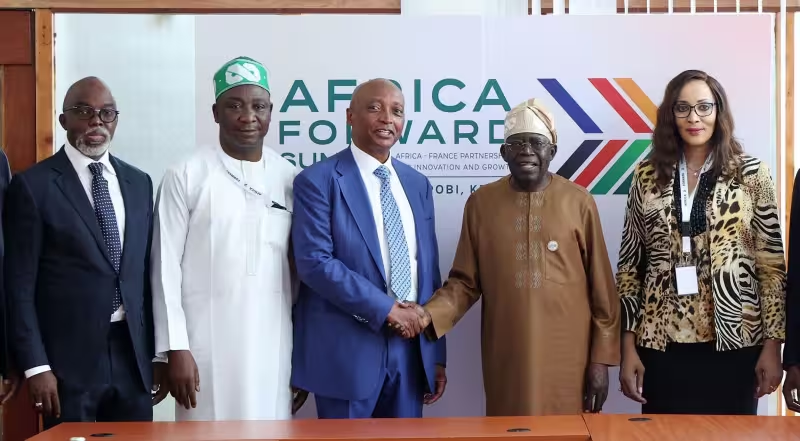
President Bola Tinubu announced on the sidelines of the Africa Forward Summit in Nairobi that he has approved Nigeria’s bid to host the 2026 CAF Awards and has endorsed the country’s proposal to stage the 48th CAF Ordinary General Assembly later this year after a meeting with CAF President Patrice Motsepe.
The meeting between Tinubu and Motsepe took place Tuesday in Nairobi, Kenya, and was attended by Bianca Odumegwu-Ojukwu, Samson Adamu, Ibrahim Gusau and Amaju Pinnick, according to organisers. CAF said the talks focused on cooperation between government, football authorities and the private sector in Nigeria and across the continent.
The announcement matters because both events are high-profile fixtures on African football’s calendar. The CAF Awards honour players and coaches across the continent, and the Ordinary General Assembly, scheduled for October, will gather leaders from CAF’s 54 member associations, representatives of its six zonal unions and senior football administrators from across Africa.
Nigeria last hosted the CAF Awards on January 6, 2017, when Riyad Mahrez won the men’s Player of the Year and Asisat Oshoala won the women’s category. The 2025 awards were held in Rabat, Morocco, where Achraf Hakimi and Ghizlane Chebbak took the men’s and women’s African Footballer of the Year honours.
Tinubu’s unilateral approval signals the federal government’s readiness to back the bid politically and logistically. Endorsement at the head-of-state level usually clears a path for host governments to mobilise funding, secure venues and coordinate security — all elements CAF will examine when it chooses a host city.
But there is a clear gap between national endorsement and CAF’s final decision. The confederation of african football has not named a city for either event; CAF is expected to announce the final host city for both the 2026 CAF Awards and the 48th Ordinary General Assembly in the coming months. That leaves Nigeria in the position of an endorsed bidder rather than a confirmed host.
The presence at the meeting of football executives such as Amaju Pinnick and diplomatic figures like Bianca Odumegwu-Ojukwu underlined the hybrid nature of the campaign: it is part sporting bid, part diplomatic push. CAF’s stated focus on collaboration between government, football bodies and the private sector suggests the final decision will hinge on assurances beyond pure venue readiness — from corporate sponsorship to cross-agency coordination.
For Nigeria, winning the bids would bring the country back into the continental spotlight. Hosting the CAF Awards would mark the return of an event last staged in Lagos in 2017, while the Ordinary General Assembly would place Nigerian administrators at the centre of continental decision-making in October. For players and officials, the ceremonies and meetings are stages where careers and policies are shaped.
The single concrete deadline now on the horizon is CAF’s own timetable: an announcement of the final host city in the coming months. Until CAF confirms a city, Tinubu’s approval converts a political commitment into a formal bid but does not secure the events. The most consequential fact is simple and immediate — CAF will decide whether Nigeria’s bid becomes a host country, and that decision will land before the calendar turns to October and long before the 2026 awards night.