




NV Energy has told Liberty Utilities it will stop providing wholesale electricity to the Lake Tahoe region after May 2027, a move that could leave 49,000 customers on California’s side of the lake without the bulk of their power supply.
“It’s like we don’t exist,” Danielle Hughes said in an interview with Fortune, summing up the anxiety rippling through the Tahoe community as officials scramble for options before next ski season ends.
Liberty Utilities serves 49,000 California customers around Lake Tahoe and currently produces about 25% of its power from solar facilities it owns in Nevada; the other 75% comes from NV Energy. Electrek reported that NV Energy told those 49,000 residents it is redirecting roughly 75% of their electricity supply to fast-growing data center demand in Northern Nevada.
NV Energy has said it needs the capacity for data centers. The shift comes as companies including Google, Apple and Microsoft have built or are planning facilities around the reno-industrial-center" rel="tag">Tahoe-Reno Industrial Center east of Reno, and a Desert Research Institute analysis using NV Energy’s 2024 Integrated Resource Plan found 12 data center projects in Northern Nevada could drive about 5,900 megawatts of new demand by 2033. NV Energy’s director of business development called the moment “unprecedented” at a regional business event last fall.
The technical reality makes the policy crunch immediate: Liberty’s grid sits inside NV Energy’s balancing authority, ties into NV Energy at 38 points and relies entirely on Nevada transmission lines. That means Liberty cannot simply buy replacement wholesale power from California without new transmission. Liberty President Eric Schwarzrock said a direct connection to California’s grid would require a new line west over the Sierra and would cost “hundreds of millions of dollars” and have significant land impacts.
The timing narrows the window for solutions. NV Energy’s decision takes effect after May 2027, leaving less than two years for regulators, companies and local communities to negotiate a new wholesale arrangement, build transmission or otherwise secure reliable supply. The California Public Utilities Commission can approve Liberty Utilities’ rates and procurement requests, but it cannot compel NV Energy to continue selling wholesale power; interstate transmission and wholesale sales fall under Federal Energy Regulatory Commission authority.
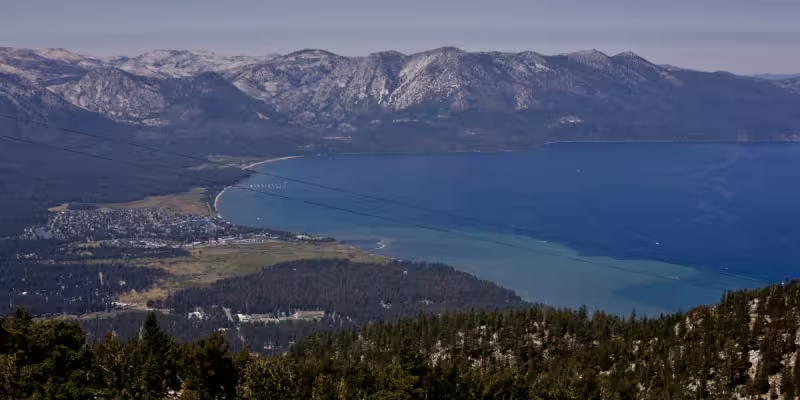
For decades NV Energy supplied the bulk of Lake Tahoe’s electricity. Now the broader scramble over data center capacity in Northern Nevada — a region that has become one of the fastest-growing data-center corridors in the country — is colliding with a tourism-dependent community. Lake Tahoe draws roughly 25 to 28 million visitors a year for ski resorts, lakeside casinos and summer recreation, and residents and local businesses warn that any months-long gap in dependable service would be disruptive to both daily life and the visitor economy.
The tension is simple and stark: the supply NV Energy says it needs to free up is the same supply that keeps lights, lifts and hotels running in the Sierra. Liberty can cover about a quarter of its customers’ needs from its own solar assets, but losing the remaining 75% supplied by NV Energy is not something that can be fixed with rooftop panels or short-term purchases. Building a high-voltage line over the Sierra would take years, carry huge costs and trigger major land-use debates; a negotiated extension or new wholesale contract would need to be reached quickly if residents are to avoid an electrical limbo after May 2027.
If regulators or NV Energy do not change course, the practical outcome is clear: Lake Tahoe will face a period of uncertainty that could force either rapid, expensive infrastructure projects or contingency measures that strain local budgets and daily life. For now the unanswered question — and the immediate one residents care about most — is whether NV Energy and Liberty can hammer out an interim deal that preserves supply past May 2027. Until that happens, Hughes’s warning hangs over the lake: “It’s like we don’t exist.”