




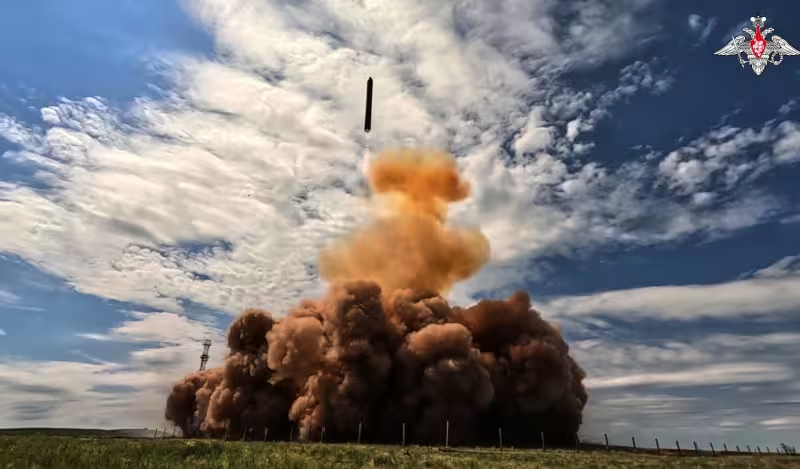
Russia on Tuesday tested a new intercontinental ballistic missile that President Vladimir Putin hailed as a breakthrough for the country’s nuclear forces, saying the launch proved the weapon is "the most powerful missile in the world" and will enter combat service at the end of the year.
The missile, the RS-28 Sarmat — called "Satan II" in the West — is designed to deliver nuclear warheads and, according to Putin, can "penetrate all existing and future antimissile defence systems" and is capable of suborbital flight. Putin also said the missile has a maximum range of more than 35,000km; the weapon has a minimum range of 5,500km.
The physical profile cited in a Washington, DC-based CSIS report in April 2024 underscores the missile’s size: the Sarmat has a maximum payload of 10 tonnes, is 35.3 metres long, three metres in diameter and weighs about 208.1 tonnes. Western analysts, however, have estimated the missile’s actual maximum range at roughly 18,000km, a figure far below the Kremlin’s public claim.
Putin said the Sarmat will replace roughly 40 Soviet-built Voyevoda missiles and repeated his earlier claim that it equals the Voyevoda in destructive power but with higher precision. The programme has been in development since 2011, and the missile was first unveiled by Putin in 2018 as one of several new weapons he said would render any prospective US missile defences useless.



The Sarmat’s testing record contains a recent public setback: one test in September 2024 reportedly ended in an enormous explosion. That incident has become part of the argument Western analysts use when assessing how quickly and reliably the new system can be fielded.
The immediate political weight of Tuesday’s launch is straightforward: the Kremlin is moving to show a working replacement for its ageing strategic delivery systems and to set a public timetable. Putin’s announcement that the RS-28 Sarmat will enter combat service by the end of the year ties the test to a near-term claim of force readiness, not an abstract long-term program.
That assertion, and the broader rhetoric around the weapon, contain sharp points of friction. The Kremlin’s claim of a more-than-35,000km range and invulnerability to missile defences is at odds with outside technical estimates that place the missile’s likely maximum range around 18,000km. The September 2024 explosion raises questions about production reliability and the program’s recent technical record. Those gaps — between Kremlin statements, independent analysis and the program’s testing history — are the real story beneath the public spectacle.
The rs-28 sarmat is now the centrepiece of a short, high-stakes timeline: a weapons test on Tuesday followed by a presidential pledge to field the missile before the year ends. If the Kremlin follows its declared schedule, the Sarmat will be replacing dozens of Soviet-era missiles within months of this test; if problems persist, the gap between promise and capability will widen and become a strategic liability for Moscow.
The single most consequential unanswered question is simple and immediate: can Putin deliver the RS-28 Sarmat into combat service by the end of the year? The answer will determine whether Tuesday’s launch is the capstone of a modernization drive or the latest chapter in a drawn-out testing program that has yet to produce an operational replacement.