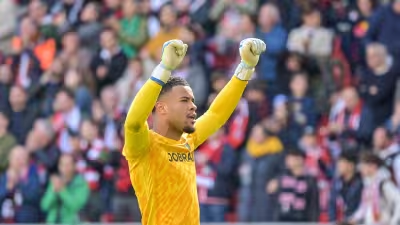





Aston Villa played Freiburg in the Europa League final in Istanbul on Wednesday, a match that kicked off at 8pm at Besiktas Park and marked the club's first European final in 44 years.
Ollie Watkins stood at the centre of Villa's pre-match focus, pointing to the turnaround since Unai Emery's arrival and reminding reporters that Villa had reached their first major European final since the 1982 European Cup. Watkins highlighted his own contribution — five goals and two assists in the campaign — and hailed the semi-final second-leg 4-0 win over Nottingham Forest at Villa Park as an almost perfect display. He said he could not speak highly enough of Emery and voiced the hope of bringing the trophy back to Birmingham.
The stakes were immediate and measurable. Emery was taking charge of his sixth European final and was chasing a fifth Europa League title after previously winning four Europa League crowns: three with Sevilla in 2014, 2015 and 2016, and once with Villarreal in 2021. For Villa the prize was not only silverware; a victory would end a 30-year trophy drought and add a continental trophy to a season that already secured Champions League qualification through a top-five Premier League finish.
Context was stacked on both sides. Emery's record in this competition has been a defining backdrop: four previous Europa League triumphs made him the tournament's most successful recent specialist. He has framed his time at Villa as a new chapter, saying he arrived intent on winning silverware and stressing that he needed to win in Turkey with the players he now has at the club. For Watkins and his teammates, the final was the culmination of an upward trajectory under Emery's management.



But the match carried friction. Emery repeatedly refused to claim superiority in the competition, explicitly saying he was not a king of the Europa League, and insisting the final was a genuine toss-up — 50-50 between Villa and Freiburg. That admission undercut the neat narrative that managerial pedigree automatically delivers another title; it acknowledged the limits of experience against the reality of one-off finals and the specific squad he now coaches.
There were practical tensions on the field as well. Villa's route to the final included high-scoring outings and a dominant home semi-final, yet European finals are decided by small margins and single moments. Watkins's five goals and two assists in the competition made him central to Villa's hopes, but Emery emphasized the need to win with the present squad rather than relying on past accomplishments. Winning in Istanbul, he said, would be another step forward for the club and for the project he began.
The immediate consequence of a Villa victory would be clear. It would end three decades without a trophy for the club, confirm Emery's unique success in the Europa League with a fifth title, and cap a season that already earned Champions League football. If Villa failed, the result would leave the narrative more ambiguous: a season of progress with European qualification secured, but a missed chance to convert that progress into tangible silverware.
Either way, the human element remained decisive. Watkins framed the night simply: a chance to bring something back to the city and to reward a season of transformation under Emery. For a club and manager tied to specific records and long waits, the final in Istanbul was not an abstract measure of legacy but a single game with immediate, concrete consequences.